Day 100 10/3/13: Seal Lullaby

I post this Rudyard Kipling poem in honor of my trip to the Marine Mammal Center tomorrow where I will meet some pinnipeds on the mend:

Seal Lullaby

Oh! Hush thee, my baby, the night is behind us,

And black are the waters that sparkled so green.

The moon, o’er the combers, looks downward to find us

At rest in the hollows that rustle between.

Where billow meets billow, there soft be thy pillow;

Ah, weary wee flipperling, curl at thy ease!

The storm shall not wake thee, nor shark overtake thee,

Asleep in the arms of the slow-swinging seas.

Pacific harbor seal in recuperation pool at th...

Pacific harbor seal in recuperation pool at the Marine Mammal Center. Photo Credit: The Marine Mammal Center (Photo credit: Wikipedia)

Day 98 10/1/13: 10,000 Walrus

One of the many dire inevitabilities of the climate crisis, so the Walrus Refugeesexperts tell us, will be an increase in refugees–probably from the world’s poorest countries—which will be hardest hit by rising seas and soaring temperatures caused by the world’s most developed and prosperous nations.

But the refugee situation is already well underway. Consider the thousands of walrus that have come ashore in Alaska, no longer able to use the summer sea ice as a place to give birth or as a diving platform to hunt for food.

I feel guilty, ineffectual and ashamed to be human. But I am human. It’s inescapable.

So I try to justify my existence. I go round and round in circles. I show these pictures to students:

Look, look! (the urgency of the first grade primer)

Don’t be paralyzed, I say (although I feel paralyzed.)

Don’t give in to despair (even though I often give in to despair)

You can do something ( I believe this)

It’s not too late (part of me fears that it is)

The whole lecture is really some inner pep talk. As I warn them about graphic images, I can barely contain my own dread, even at the most familiar documentaries and exposes. As I rally students to change the world, I tell myself: At least don’t shut your eyes.  At the very least, keep going.

Day 93: 9/26/13: Befriend a Bull Shark

Bull shark populations have declined up to 90% from finning pressures. You can donate as little as $10 and get various perks: a shout-out on  Twitter or FB,

Bull shark

Bull shark (Photo credit: Wikipedia)

a personalized certificate all the way up to an autographed vintage JAWS t-shirt.

Click here to adopt!

Day 92: 9/25/13: Afternoon with a Shark Legend

I am still ecstatic from Ralph Collier’s lecture this afternoon at Glendale College this afternoon. Great turn out–students, teachers from all disciplines, and people from outside school–including one dazzled shark nerd in a Jaws t-shirt who sat in the front row, and my dear friend Lisa and her fellow shark fanatic pal, Jack.

Ralph covered some fascinating stuff about shark behavior including “spy hopping” in which white sharks (and apparently oceanic white tips) stick their heads out of the water to check out what’s happening on land and sometimes startle random seals off the edges of rookeries. They also spy hop to calculate which group of seals in the haul-out area might be easiest to sweep into the water via a giant breach. Essentially, I learned that white sharks ain’t dummies. Not by a long shot. They have memories. They make calculated decisions. Ralph doesn’t believe in calling shark encounters “accidents”–he gives the animals volition—whether the intent is to investigate or to launch a predatory strike.

I learned two more disturbing consequences of shark finning:

1. When the discarded bodies of finned sharks are thrown overboard, they sink to the bottom where ammonia leaking from their ravaged bodies destroys coral communities.

2. Increasing numbers of people in Asia who consume shark fin soup are developing neurodegenerative diseases including Alzheimer’s, Parkinson’s, and A.L.S.  Researchers have proposed that the high concentrations of mercury in shark fin and flesh bind with other neurotoxins and create a lethal toxic compound. Could this new health concern become a powerful force in stopping finning?

Continue reading

Day 91 9/24/13: Ralph Collier’s Awesome Resume

Writing the introduction to Ralph Collier’s lecture tomorrow. This man knows everything about white sharks from their interactions with people to their inspections of inanimate objects and sea birds. He was the first to notice how white sharks roll their eyes during predatory or investigative attacks. The Egyptian Government asked for his help after a series of attacks in the Red Sea in 2010. He’s appeared in 50 documentaries, his work cited in over 300 publications. He’s written stuff on white shark dietary habits, and how they see colors and respond to sound.

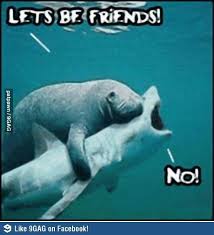
It is a fascinating thing—the devotion of one’s entire life to understand the behavior of such an alien creature…. I wonder how one might compare this obsession with sharks to the obsessive drive of the artist?   It’s a question that I’m frankly too tired to contemplate, so here’s a meme:

Codependent No More

Day 87: 9/20/13: The Lemon Sharks of Jupiter

You know what really pisses me off? When people use the word “harvest” to refer to hunting animals. As if bears were wheat or lemon sharks were lemons. Of course, “harvest” is only one of many really awful euphemisms like “animal research,” or “by-catch.”

Maybe the bigger question is why human beings seem hellbent on killing the things that are already disappearing?

For the vanishing lemon sharks of Jupiter Florida, the National Marine Fisheries Service has proposed that the new “harvest” date begin on January 1, 2014  just as the sharks are gathering to give birth to their pups.

Please read this post from Sharksavers and leave your comments for the NMFS asking them not to change the opening date of fishing season.

The comment period closes Monday, so please take action this weekend. It will only take 5 minutes or less!

English: Lemonshark

English: Lemonshark (Photo credit: Wikipedia)

Day 76 9/9/13: Mourning, Millennials & Melodrama in “Jaws”

I had to remind myself to take a deep cleansing breath when I noticed a few of my students texting during “Jaws” today. Later, one of the guilty boys confessed the movie was “just too scary” and with the acute senses of a predatory fish (or a fellow neurotic), I detected residual fear in the shuffling way he gathered his books and hid his eyes behind a lank of  dark hair.

Several people laughed when the bereaved Mrs. Kintner slaps Chief Brody in the face for keeping the beaches open and letting her son Alex get chomped. Is this a kitschy moment? Perhaps. But I always found the scene too odd or mysterious to be pure melodrama. The black-veiled Mrs. Kintner is accompanied by a silent old man who might be her father or grandfather and the two of them progress in some odd inversion of a  wedding march toward Brody.

As Antonia Quirke noted in her BFI essay on “Jaws”: “She’s much older than the other mothers at the waterfront. This child was her last chance” (35). Quirke also notes that a slap in the movies normally stands in for sex, but “[t]o be slapped by Mrs. Kintner in mourning is like being kissed by a skeleton, it has that disquieting taboo mixed in” (36).

The book store ran out of my shark texts which may have explained this group’s lack of enthusiasm for uterine cannibalism or the ampullae of Lorenzini. So other than typing up a quick shark biology quiz, I’ve been checking in with the STOP OCEARCH activists. Sad to hear that the New Yorker did a story about OCEARCH (thanks for the tip, Connie), but pleased to know that a film exposing these charlatans (Price of Existence) and other marine exploitation is in the works. I’ll try to do what I can to help with the fundraising/consciousness raising for this project.

Day 74: 9/7/13: Save The Turtles (Feed the Sharks!)

A lovely day at Zuma Beach volunteering for Oceana at the Malibu triathlon. Last summer, I asked surprisingly willing triathlon swimmers to sign a petition to protect California’s great white shark population (ultimately the National Marine Fisheries declined despite the dwindling numbers). This year: loggerhead turtles. I had that same squishy uniquely human whose-side-am-I-on-anyway? feeling as I talked about the increased need for habitat for sea turtles, knowing that tiger sharks particularly love to feast on them.

Ultimately I realized that my position as a human isn’t necessarily  to root for one side, but to attempt to restore some part of the balance that humankind with its plastic, its miles of nets and hooks and acidified seas has destroyed. Nature, of course, is often brutal and so I’m moved when people fashion artificial flippers for a sea turtle crippled by sharks.

I know that human belief in our separateness from nature is the root of most of our problems. But my humanness will always make me feel like a distant admirer of animals, an apologist for my species, a loving outsider. As a kid, I wanted to be like Fern in “Charlotte’s Web,”–so much a part of the animal world that they “forgot” I was there and gossiped freely. Now, I don’t know if I seek a window into animals’ secret world  so much as I need an alternative to the crowded, relentlessly human one I inhabit.  Maybe it’s as simple as the epiphany I had a few weeks ago when admiring the crazed smile of a moray eel: “I like the other.

A baby Loggerhead Sea Turtle

A baby Loggerhead Sea Turtle (Photo credit: Wikipedia)

Day 71: 9/4/13: The Shark Sees My Soul & Finds It Lacking

Section 2 of my shark class met today. Instead of trying to decipher their stony expressions (anxiety, indifference?), I let them write a page describing how they felt about the ocean. One girl told me about her fisherman father who is legally blind and makes his own hooks. Although she is a vegetarian, she respects that her father only catches a fish or two at a time, because it’s better than factory farming. Oh the sheltered bliss of youth! While her father may catch only a poor hapless specimen or two, she has yet to discover the “factory farming of the sea” that is industrial fishing.

Sifting through the narratives of fear of drowning, fear of plankton, joyful memories of the dolphins of Anacapa, I found one student that took an overnight trip to SeaWorld with her seventh grade science honors class and dissected a squid there, another who tried to overcome her fear of sharks by standing in the “shark tunnel” at the aforementioned aqua prison, but confessed, “I didn’t last more than a few seconds without tears rolling down my face. I just can’t face them.” (emphasis mine).

Besides turning every single one of my students against SeaWorld, I look forward to exploring their fear more deeply.

“I just can’t face them,” seems to endow sharks with the power not only to kill, but to see inside the human soul and detect some moral failing there. I thought cats alone possessed this ability.