Day 250 3/2/14: If You’re Feeling Lost….

This is a poem by Robert Frost called “Directive.” 

Back out of all this now too much for us,

Back in a time made simple by the loss

Of detail, burned, dissolved, and broken off

Like graveyard marble sculpture in the weather,

There is a house that is no more a house

Upon a farm that is no more a farm

And in a town that is no more a town.

The road there, if you’ll let a guide direct you

Who only has at heart your getting lost,

May seem as if it should have been a quarry—

Great monolithic knees the former town

Long since gave up pretense of keeping covered.

And there’s a story in a book about it:

Besides the wear of iron wagon wheels

The ledges show lines ruled southeast-northwest,

The chisel work of an enormous Glacier

That braced his feet against the Arctic Pole.

You must not mind a certain coolness from him

Still said to haunt this side of Panther Mountain.

Nor need you mind the serial ordeal

Of being watched from forty cellar holes

As if by eye pairs out of forty firkins.

As for the woods’ excitement over you

That sends light rustle rushes to their leaves,

Charge that to upstart inexperience.

Where were they all not twenty years ago?

They think too much of having shaded out

A few old pecker-fretted apple trees.

Make yourself up a cheering song of how

Someone’s road home from work this once was,

Who may be just ahead of you on foot

Or creaking with a buggy load of grain.

The height of the adventure is the height

Of country where two village cultures faded

Into each other. Both of them are lost.

And if you’re lost enough to find yourself

By now, pull in your ladder road behind you

And put a sign up CLOSED to all but me.

Then make yourself at home. The only field

Now left’s no bigger than a harness gall.

First there’s the children’s house of make-believe,

Some shattered dishes underneath a pine,

The playthings in the playhouse of the children.

Weep for what little things could make them glad.

Then for the house that is no more a house,

But only a belilaced cellar hole,

Now slowly closing like a dent in dough.

This was no playhouse but a house in earnest.

Your destination and your destiny’s

A brook that was the water of the house,

Cold as a spring as yet so near its source,

Too lofty and original to rage.

(We know the valley streams that when aroused

Will leave their tatters hung on barb and thorn.)

I have kept hidden in the instep arch

Of an old cedar at the waterside

A broken drinking goblet like the Grail

Under a spell so the wrong ones can’t find it,

So can’t get saved, as Saint Mark says they mustn’t.

(I stole the goblet from the children’s playhouse.)

Here are your waters and your watering place.

Drink and be whole again beyond confusion.
Day 248 2/28/14: “All Places Exist in the Body”

Some truths we think we know. Then we actually live them. For me, one such truth is: “All places exist in the body.”  I first fell in love with this concept in 1995 at U.C. Berkeley when a poetry teacher of mine mentioned it.

In the class, I wrote a short piece about a guy I’d been absolutely nuts about when I was very young—this poem was economical, but full of dreamy sensuality and ribs rising, and concluded with a kind of hazy philosophizing that nothing was really lost if “all things exist in the body.” I changed “places” to “things” thinking there was really no difference.

But I didn’t know then that remembering with the body means more than a breathless nostalgic lust, or the addled mind throwing the mostly forgotten body a bone.

All places exist in the body. The distinction matters.

When my father died, leaving the house I had known and loved and returned to for 44 years to his mentally unbalanced wife, I became an exile. We’re all exiles. We were born exiles, after all. But we live here a while and we forget. Then someone dies or the door forever closes on some beloved place.

I learned that losing a place does not feel the same as losing a person.  And while I know better than to apply linear timelines to grief, when the initial shock and frequent, exhausting crying jags over my father subsided, the house, the fields, the woods moved in.

They took residence in my body in a way that memories of the dead never have. The opposite of an exorcism, a new settling began. I now understood that properly remembered, a well was also a throat, that doors were breasts, that the lifting of old latches, the bark of disappeared trees, all the obscure pleasures of warm mud and cold stone had to have some place to go. But not to become projections–the ever-thinning, forever looping films of the mind. These things had to go where they could grow, a place where all the restless spirits of habit could find their place.

This kind of remembering, this very physical presence that aligns the outside with the inside, so much that teeth take on the silent weight of stone walls, this kind of memory-as-occupation feels at times almost supernatural. I tried to tame it with a poem:

A moon-bright field raises hairs on the arms.

Wrists go numb remembering dark brooks.

Horses become instinct, thirst.

What it can no longer return to

in the old way, the body rebuilds, reclaims

as if to say: there was always only here.

Is this wholeness at last?

The translation of all loved things

to their essence

The barn less brick

than silence that agreed for a time

to gather itself into manger and beam

The poem ends, but the house still shows up. What does it want of me? There is no danger of forgetting.

Maybe only a simple transmission of information, the declaration of an obscure fact:

On the cellar walls, long ago strangers recorded snowfalls in soft pencil, along with recipes for elderberry wine. We added to these our own statistics of startling snowfalls, how much fell, how little stayed. In the barn, the births and deaths of horses are written in blue on the inside door of a hay strewn cupboard.

I don’t know what this means. Carried in the body, it no longer even feels like a memory, just a code that if finally broken, might save someone else.

Day 236 2/16/14: A Sad Poem by Abraham Lincoln

I’ve never read an Abe Lincoln poem before, but I found this one really moving.

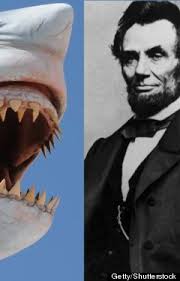
If you hate poetry, take Who said it: Abraham Lincoln or a Flying shark?  a quiz from Huffington Post.

Unknown-1

My Childhood Home I See Again

My childhood home I see again,

And sadden with the view;

And still, as memory crowds my brain,

There’s pleasure in it too.

O Memory! thou midway world

‘Twixt earth and paradise,

Where things decayed and loved ones lost

In dreamy shadows rise,

And, freed from all that’s earthly vile,

Seem hallowed, pure, and bright,

Like scenes in some enchanted isle

All bathed in liquid light.

As dusky mountains please the eye

When twilight chases day;

As bugle-notes that, passing by,

In distance die away;

As leaving some grand waterfall,

We, lingering, list its roar–

So memory will hallow all

We’ve known, but know no more.

Near twenty years have passed away

Since here I bid farewell

To woods and fields, and scenes of play,

And playmates loved so well.

Where many were, but few remain

Of old familiar things;

But seeing them, to mind again

The lost and absent brings.

The friends I left that parting day,

How changed, as time has sped!

Young childhood grown, strong manhood gray,

And half of all are dead.

I hear the loved survivors tell

How nought from death could save,

Till every sound appears a knell,

And every spot a grave.

I range the fields with pensive tread,

And pace the hollow rooms,

And feel (companion of the dead)

I’m living in the tombs.

Day 211 1/29/14: Why I Write

I wrote this as an assignment in a workshop that I’m taking & thought I would share.

It’s interesting to remind myself why I continue to  write when I bitch about it constantly.

WHY I WRITE

In adolescence, I felt driven by a mania to record, an anxiety about days slipping by. No experience had been fully lived until I transcribed it in my notebook. I remember the minutiae of make-out sessions, the margins full of life. Now at middle age I’m even more aware of time passing, but I’m gathering up all those journals I’ve kept since 13, choosing only a representational sentence or two from each year and throwing them away. I want to record my feelings about time.  Will tossing piles of antique store ledgers, cheesy clothbound “nothing” books will feel like liberation, or a bandage ripped off too soon?

I will write about the experience of turning many books into one.

            Writing is a way of seeing. I’m not a painter or a scientist, although like Keats said, I’m aware of how the poet inhabits other ways of seeing. Although I love painting, I don’t see the world in terms of line or color.  I love nature, but I am far too messy to be scientific.

I write because I’m haunted by language. Lines get stuck in my head. In the summer of 2001, I could not stop thinking: “Late at night, when the signal is clear….” I don’t think I ever used it, but it led me deeper into the experience of summer. The landscape seemed to conform to it. Through its effortless repetition in my head, I saw correspondences, communion where I might have simply seen house, grass, trees, stonewall. That thin fragment unified everything.

I can’t figure out why I’m alive, so I write to justify my existence. I agree with the philosopher who said, “We all come here with sealed instructions.” Mine must have to do with writing, since it is the only skill I have. Through willed ignorance, learned helplessness and genuine indifference, I can’t do much of anything else. I’m in awe of  friends who make clothes and fix sinks, dig gardens and train dogs. I think of a certain line over and over, wearing it down in my head until the marrow shines through, or let it drift so it retains its essential lightness on the page.

My brother can build a house. I construct and dismantle shelters of words. Leaky, eccentric, or structurally unsound, but still I build and rebuild. Sometimes I inhabit one for a while, but I never get too comfortable. In writing, there’s only a fleeting sense of “home.” But if I can articulate that absence incisively, or at least beautifully on the page, then at least I’ve created a temporary refuge.

043

Day 194 1/5/14: A Post-Christmas (Sort of) Fable

images-2The other day walking around the Hollywood Reservoir, I  discovered a tree covered in Christmas decorations. Two trees actually. “Festooned” with decorations might be pushing it, since this is January and as glittery it appeared, a tinge of belatedness vibrated at the edges. Large silver bells, flat stencil-style presents and glittery disco-style bulbs that are either silver or green and garland gold and ribsy. Everything shone in that I-don’t-recognize-the-meaning-of-January Los Angeles sun.

As I paused at the tree, some weird cocktail of juvenile delinquency and middle-aged nostalgia intoxicated me and I thought about stealing one of the silver disco balls. After all, it was Christmas and surely this tree had been decorated for a lark anyway and stealing was probably built into the design of a publicly decorated Christmas tree. But almost as soon as this impulse surfaced, like a good ex-Catholic, I immediately drown it in a tidal wave of shame and self-loathing.

Then I noticed the sign spinning and breathing among the ornaments. Handwritten and cardboard it said something like:

PLEASE DO NOT STEAL OUR ORNAMENTS. EACH ONE REPRESENTS SOMEONE WHO CAN NO LONGER WALK WITH US.

I’ve been trying to develop a more sophisticated version of God than “hypercritical eyeball that reads your every thought,” but this sign wasn’t helping.

As a kid, I read our Christmas tree like some annual, familiar, but always slightly altered text. The ornaments had specific histories, and their placement in the branches varied, and so the story they retold each year created slightly altered tones and new narrative possibilities. Only the nativity scene with its jagged broken donkey ear assumed the same position—perched on two barely developed branches near the trunk in the dark center of the tree. I always knew where it was, and yet my eye always came upon it as the surprised or lost child in a fable encounters a house in a primeval clearing.  The story I usually concocted had something to do with the proximity and juxtaposition of the holy and the kitschy–the baby Jesus bathed in the red and green light of the lights. On that outskirts of that sacred hollow, a Snoopy with antlers instead of beagle ears skated on an invisible pond.

We had had a tarnished silver disco ball on our Christmas trees in the 1970s, but my favorite ornament was the glass red Silent Night bulb with its white church steeple and its simple wave of snow. It reminded me of the words of another hymn—“The First Noel” and its cold winter’s night “that was so deep.” The line stuck with me long after midnight mass  because I could sense eternity in it. That a night could be deep made me reconsider darkness itself as it settled over our house and across our fields.  That sort of deep rolled like a storm cloud. It unfurled like a passage, wide and silent.

I suppose light has its own depth. The cardboard sign, somewhere between a plea and a warning framed itself in needles of light that jumped off the haphazard garland. It reflected me back at myself like the disco ball ornament I’d considered stealing. If I was living a myth (and who says I’m not?), my theft of the ornament would end in a haunting, my guilt fractured into a thousand spirit fragments in the  miniature mirrors of the disco ball that I’d hung it blithely on my rearview mirror. Distracted by its mocking, spinning death whirl, I might drive my car into a ditch and no one would know I’d died of a heart attack brought on my ghosts before internal injuries.

This is the season of the naked and the abandoned. The fallen.  Christmas trees haunt the alleys. I find the sight of these briefly coveted messengers of joy quite depressing. A tree if it is to be sacrificed, surely deserves to be an object of contemplation longer than the Christmas season or at least recycled to return in some fertilizing capacity to the earth. Passing these desolate trees on sidewalks, I feel their silent reproach. It’s as if I’m in church all over again: I died for you. There is something that sees hidden deep in those branches, something stolen from the pagan forest dragged inside and draped with new religion, then stripped again and forgotten.

I  like to imagine the tree on the edge of the Hollywood Reservoir still decorated in May or June, surprising those running or walking along the sandy shoulder of the road, the silver bells in the silent dry light of summer, the ragged breath of garland, the words lodged in its living branches.

Day 125 10/28/13: Remembering Lou Reed, Andy Warhol & An Old Horse

I wanted to write about the shark presentations my students gave, but most of them were lifeless recitations of Powerpoint slides, and I found myself thinking more about Lou Reed.

I played his music all last night.

What does it take to crack open the human heart? I don’t know why I’m surprised at my depth of feeling at Lou’s death.

Had I forgotten the heavy thrill of buying my first VU album, “White Light, White Heat,” of memorizing “The Gift”? How I used to keep a picture of Lou Reed in my photo album among images of my family? Why did I not even own this music I loved so much anymore? I’d memorized every song.

Between classes, I tried to lose my despair over the death of a major artist and the death of collective student imagination, in an essay about horses called “Partnering with Pegasus.”  Mares are the true leaders of the herds, not stallions.  I started thinking of 1992,  the last time I saw my childhood mare-ribsy and grizzled, 35 years old coming over the edge of a hill. She nickered when she spotted me, but I, shocked at her appearance, gasped.

Then we both froze staring at each other.

What a great surprise to find that horse standing in that field again.

The image hung there, and suddenly infusing that lost world was John Cale singing “The Style It Takes” a gentle song about Andy Warhol:

I’ll put the Empire State Building on your wall,

For 24 hours, glowing on your wall

Watch the sun rise above it in your room,

Wallpaper art, a great view…..

Did they always belong together this unlikely memory pair–an elderly horse and lonely Andy Warhol?

I started thinking of that well-worn Camus quote about having an infinite summer within. The places I’m afraid to return to, those fields, those songs (which are also places), are sites of renewal. Loss numbs and loss  surprises. Like music it wakes us up again to the dream of life.

Day 122 10/25/13: Overheard While Meditating

Cropped screenshot of Humphrey Bogart from the...

Cropped screenshot of Humphrey Bogart from the trailer for the film The Petrified Forest. (Photo credit: Wikipedia)

Last night I had the first shark dream in a long time. I only remember fleeting details: night sea (a common setting),  a white belly, a thin black line for a mouth. Although sharks rarely  drift through my dreams, they often materialize in my meditations, appearing and disappearing just as they do in the oceans. Silent images—another kind of thought.

When I meditate in my little office at school, I hear the urgent scratch and peck of someone writing in chalk on the other side of the thin wall. Across the hall, hollow and booming, lectures on economics: the virtues of spreadsheets, the falling markets. When I meditate at home on the couch, the blissful silence is often invaded by street noise. How I achieve higher consciousness when I can’t even transcend Los Angeles? Applause and laughter erupt from the 12-Step meetings in the church basement next door. Other times I hear one-sided Hollywood phone conversation– an unseen starlet squealing about an upcoming audition, or a deep-voiced man describing an upcoming job to a potential stunt guy:

So here’s the scene:

The wife is cooking for her in-laws (car roars past) and so she takes butcher knife and cuts off her husband’s (motorcycle speeds by) and feeds it to him. Think you can do that? Can you light yourself on fire? Are you good with smoke? Knives? The husband’s a football player-esque type. Your general asshole.

If all of life is an illusion, Los Angeles is the illusion within the illusion. Living here for so long, I’ve experienced many a surreal collision between past and present, the living and the dead. Walking through the Hollywood Forever cemetery, I once found a man building a styrofoam mausoleum for a horror film. It  looked as solid and cold as the actual stone tombs that house the first movie stars and passengers from the Titanic.

Even if my meditations are often interrupted, L.A. feels like the perfect place to contemplate the fleeting nature of all things.

Driving through a block of Hollywood Boulevard, I once found myself surrounded by cigarette billboards and 1940s cars, under a marquee advertising a Humphrey Bogart movie. I needed a few minutes to orient myself, to understand this movie wasn’t a revival showing, not a matter of nostalgia, but a meticulously organized, briefly resurrected world as bright and new as it must have been in 1945, that would likely be gone by morning.

Day 119: 10/22/13: On Mothers & Shipwrecks

English: Illustration for "The Wreck of t...

English: Illustration for “The Wreck of the Hesperus” by American poet Henry Wadsworth Longfellow. From Illustrated Poems and Songs for Young People, edited by Mrs. [L.D.] Sale Barker. Published 1885. (Photo credit: Wikipedia)

Another blurred batch of sea poems today. That none of the students chose “The Wreck of the Hesperus,” that morbid Longfellow melodrama that my mother used to recite, left me vaguely disappointed and relieved. No one could have owned “Hesperus” like my mother with her thick Salem Mass. accent. I cannot read it without hearing her voice. The skipper of the Hesperus binds his daughter to the mast during a violent storm. She, being  a rather chatty child, keeps asking the beleaguered old salt questions that he patiently answers until the twelfth stanza:

O father! I see a gleaming light,

Oh say, what may it be?”

But the father answered never a word,

A frozen corpse was he.

In Ma’s dialect, corpse became a very earnest “caawpse” and I had to suppress my delighted laughter or she would not continue to my favorite part:

Lashed to the helm, all stiff and stark,

With his face turned to the skies,

The lantern gleamed through the gleaming snow

On his fixed and glassy eyes.

I loved the lantern. I loved the snow. I loved the odd repetition of “gleamed” and “gleaming” and I loved death’s glassy stare.

Continue reading

Day 96: 9/29/13: Between Breaths

Back to the pool today to review some safety procedures after last week’s debacle at sea.

Thoughts I had while trying to achieve neutral buoyancy at the bottom:

1. Tried to remember the name of the guru who said, “My religion is breath.”

2. Yoko and John’s fabled first encounter at the Indica Gallery in 1966: She handed him a card that said “Breathe.”

3. What my brother told me about coming home from a recent road trip to Vermont with a bushel of sweet “wild apples.” The beauty of those two words together healed something in me.

4. How the peace one feels underwater is a kind of addictive silence, like the silence of meditation. So many kinds of silences, far more than there are kinds of apples.

5. What a strange honor it is to be with someone while they take their last breath, their last taste of the world.

6. My father and I used to race our horses through an apple orchard. The horses had white apple foam on their lips. At a certain point, I crossed some invisible, unspoken line and he stopped letting me win each race.

7. The fundamental law of diving and of life: don’t hold your breath.

8. The curved forms of the free divers that swim with sharks. They know how to move so as not to appear threatening. Their bodies are lithe, beautiful. They are seeking, it seems to me, some impossible form of communion.

9. Manannan mac Lir is an Irish sea deity. He is a clown, a beggar, and a psychopomp who guides souls to the underworld.  He’s associated with the Isles of Apple Trees in the next world.  In a painting I saw once Manannan mac Lir took the form of a breaking wave of horses. I remember the fury of the foam.

10.  My dive teacher takes the regulator out of his mouth. He lies on the bottom of the pool and blows these crazy rings of air to the surface–huge and perfect. They shiver and break apart. I immediately think of my father smoking cigars while he watched 60 Minutes–the hazy rings, not weird and futuristic silver water rings, but earthly like the rings of a tree. What good does it do to remember so much? My teacher gives me the signal: Are you ready to ascend? I have almost forgotten where I am. I nod. Yes. I am ready. I look to the surface.  I breathe.

Day 94 9/27/13: In Praise of The Condemned

I just noticed how dusty my bookshelves have become and this saddens me. Writing a blog while bemoaning the changes technology hath wrought, seems sort of hypocritical, but I guess what I am really bemoaning (if that’s the right word) is that my attention is so much more fractured than it used to be. I almost need to teach myself to read for sustained periods again. I find myself trying to download something, sign a petition, comment on a post, and I always forget what I am doing, where I am going. Several windows obscure my desktop. Tabs abound. Yet in my mind I see the same simple images: a blue road snaking into the woods where I grew up. A kind of automatic pilot mourning process that unfolds while I am busy typing and clicking and forgetting the myriad tasks and distractions of the present.

For weeks, I have been talking about doing more for sharks, for the environment and today I signed up for some lectures to learn more about using blogs and social media, so that is a step forward. I feel like I am on the verge of understanding how to combine literature, writing, activism, etc. into some sort of non-profit project. I talked to some man just as I was leaving campus today. We stood on the pedestrian bridge. Below workers and machines excavated a new construction project. He pointed out two native oaks–I believe they were 100 years old or more—that were condemned. Diseased. “It is sad, but they must come down.” I understand that trees get sick. I still dream of trees that perished from Dutch Elm and the salt damage from winter roads.

But as I gazed at the distant pair of elms waving slightly in the breeze near the duplication office, I wondered how any tree could really be condemned. And I thought of all the things those trees had seen. All the history that would die with them. After so many months of heat and stillness, I am alert to the breezes and to the wind and how they animate the trees and people alike. I don’t know what this has to do with taking classes on blogging, or with sharks except that sharks, I believe, are older than trees and that this project has sharpened my sense of all that is beautiful and all that’s vanishing and how intertwined those two things often are.

English: Dutch Elm Disease strikes Badingham O...

English: Dutch Elm Disease strikes Badingham One of our larger trees a couple of years after being struck down. Now (2008) hard to see where the tree was. (Photo credit: Wikipediat