Day 317 5/8/14: On Childhood & Shelter

Having become infatuated with the idea of divesting, of giving away, of selling, losing things, I find a worn and heavily annotated paperback at a book sale: The Poetics of Reverie: Childhood, Language and the Cosmos by Gaston Bachelard. Having loved his other books The Poetics of Space and The Psychoanlysis of Fire, I buy it for 50 cents. Although the acquisition makes me queasy, I also believe that books find us when we need them. I open to a page at random:

A beautiful poem makes us pardon a very ancient grief.

I take the book to the newly clean Echo Park Lake. I have an hour or two before I go downtown to the architecture school where I will do phone interviews with incoming students. The newly clean lake is full of lotus flowers. On the surface, they are the pink flowers I’ve seen on the front of countless books on Buddhism, pink-edged metaphors for unfolding, for beauty that is possible in the muck and maya of the world. Beneath the water, in the haze of silt, the pale green roots serve a practical function. The frogs lay their eggs among the stalks, a submerged forest, a place for trout to rest.

Bachelard quotes the poet Friedrich Holderlin:

” ‘Don’t chase a man too quickly from the cabin where his childhood was spent.’ ” Isn’t this request by Holderlin addressed to the psychoanalyst, that bailiff who believes it is his duty to chase man away from the attic of memory where he would go to cry when he was a child?  The native house—lost, destroyed, razed—remains the main building for our reveries of childhood. The shelters of the past welcome and protect our reveries.”

A mother duck and eight ducklings glide into the floating lotuses. The ducklings walk across the broad, floating leaves, heads of fuzz, maniacally pecking at some invisible feast.

Later I drive aimlessly above the squalor of Sunset to a gorgeous street of trees, grand houses with broad porches, stately Victorians. One of the palatial lawns is covered with chairs. I can’t tell if the family is moving in or out of the brown shingled mansion.

On the way downtown, I think I recognize an embattled stucco house at the top of a terraced hill that should lead to a temple, not to a sad bungalow. I’m convinced that I’ve seen the house before in a movie about a gypsy with a milky eye. And that other house, the one above the faded 80s mural of the runners with their hair swept back in the wind, starred in a movie about love ending. I remember how it perched, a dark nest above the syrupy ribbon of the freeway.

As I drive to school, I think of childhood shelters and all the facades from nameless movies that have become inseparable somehow from real-life buildings, like a rain-soaked magazine I found in a ruined house, the image and text a blur and tear, a one-ness.

At school I pick up the phone, call a student in China. Just to chat. To see if he could use an extra English class before beginning his fall program.

Tell me about yourself, I ask. What are you reading these days?

Bachelard, he says. He writes about childhood and space.


Day 313 5/4/14: My Pagan Yard Sale

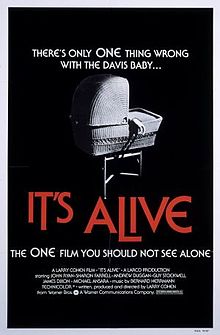
A man at my yard sale held up two DVDs: “Rosemary’s Baby” and “It’s Alive.” The cover of the former features an ominous baby carriage on a hill. In the background Mia Farrow’s dazed and staring face fills the sky. On the other cover  a sharp demon hand dangles over the side of a bassinet.

“Same movie??”

The wispy ghosts of my high school Spanish deserted me.

How could I surmount the language barrier and assert the vast superiority of Polanski’s movie?

“Both demon babies,” I said. “But “Rosemary”  was made first, in 1968. It’s much better. You never see the baby.”

“So..same movie?”

“No different movie. Both Satan’s baby, but different. Different plots.”

“I see. So they are the same.”

All the many years of cultivating my discerning aesthetic seemed irrelevant in the withering heat. I took the dollar he offered for “Rosemary’s Baby,” and watched him reluctantly place “It’s Alive” back in the ripped cardboard box from which it had come.

“Take them both,” I said. “You’ll see.”

Why did I own so many horror films about demon children? Only minutes before I’d watched wistfully as a smiling, very focused man with red sneakers and wisps of white hair wreathing his temples snatched my copy of the 1979’s “The Brood.” At the end of the afternoon, when only the dregs remained, a tall collegiate looking girl rescued Tarot cards from the bottom of a box, and lingered over the books, trying to choose between Famous Statues and Their Stories and The Cat in Ancient Egypt.

She finally decided on the statues.

“There’s a lot of witchy stuff here,” the college girl confided to my friend Deirdre, tugging absently on her U.C. Berkeley lanyard.

She then confessed she was going to cut my 1930s art book up for collages, which struck me as a rather brutal form of creative “magic.”

By the end of the long, unbearably hot day, when my DVDs were mostly gone and a few stray cards from an animal magic divining deck littered the sidewalk, a friendly family arrived.

A young woman who walked with a limp approached me and I showed her the boxes I’d packed up for Goodwill.

“Take anything you want.” 220px-Itsaliveposter-1

“I have a weakness for books,” she said, “I’ll take any books.”

Isn’t it strange how easy it is to feel love for someone you don’t even know?  I gave her the box full of books on art, on love, on witchcraft, old Gothic paperbacks with dry attic-sweet pages, books on movies. She accepted it all with enthusiasm, even wonder. I handed a woman who must have been her mother a pair of 1950s decorative cats, a white 50s ashtray, “Thank you, Thank you….!” I piled each of them high with stories I’d loved or pictures I’d studied or ephemera from the dead I could no longer carry. They didn’t subtly imply that I might be a practicing Satanist, or ask me to explain the fine lines that separated one doomed birth from another. They didn’t inquire why I might be handing off these once-beloved parts of myself to strangers. They just opened their arms in gratitude.


Day 310 5/1/14: Facing It

About a month ago I was sitting in a little windowless office at school chatting with my friend and fellow adjunct, Emily.

I was blabbing to her about the end of this blog. How this year I’ve written about all kinds of things outside of sharks, I’ve written about my mother’s life fading and grieving the loss of my father. And even the activism—the petitions signed, the protests and teaching, the Jaws Benefit, all of it seems a bulwark against vanishing. Soon, and finally, I’ll be going on this trip to see the sharks in South Africa.

“I have to see how it all fits together,” I told Emily, “to make a book out of it.”

“Well, going down in the cage is your confrontation with death,” she said.

I know she didn’t just mean I was off on some “extreme” adventure, some chance to stick my head in the maw of oblivion, but my confrontation with all of it.

marysharkI knew this. It seemed both revelatory and obvious. I must have said or written or voiced it before. But why when I heard Emily say it did I feel a weird hush inside me—the kind of sea silence I imagine myself descending into?


P.S. I stole this title from a fantastic poem about the Vietnam Veterans Wall by Yusef Komunyakaa.

Day 308 4/30/14: The End of the Cull & Deadline for Dusky Sharks

West Australia’s cull has ended-–for now. The drum lines have been pulled. 100 sharks have been caught, and though the Premier claims that killing 100 sharks (no great white sharks—the species responsible for the attack), has been “educational.” Let’s hope this barbaric policy doesn’t return in November.

If you’d like to do a good deed for dusky sharks, an overfished species and help end the use of wasteful longline fishing in the Atlantic, Gulf and Caribbean, here today is the LAST DAY. You can read about the proposal here. (Thanks to shark superstar Sarah Mucha for this information!)

Please e-mail  your comments to: Peter.Cooper@noaa.gov 

Subject: Amendment 5b (A5b) to the 
2006 Consolidated Highly Migratory Species 
Fishery Management Plan


Either submit your own original comments, or cut, paste & sign a version of this sample letter:

To Whom It May Concern:
I am writing in reference to the comment period on Amendment 5B (A5B) to the 2006 Consolidated HMS Fishery Management Plan. My comment is as follows-
POTENTIAL RECREATIONAL MEASURES
It is my opinion the closure of the Atlantic recreational shark fishery “ALT-A8” would have the most impact on helping reduce the number of incidental landings of Dusky sharks. If this measure is unattainable I feel the next appropriate measures would be to combine “ALT-A3” for public awareness on regulations and shark identification, “ALT-A4″ prohibiting retention of all ridgeback sharks in the Atlantic Recreational Fishery, ALT-A5” extending end of existing shark closures from July 15th to July 31st would give added protection to nursery areas, along with “ALT-A7” allowing only catch and release of all Atlantic HMS managed sharks and retention of recreational caught sharks prohibited would all help meet the goal of reducing mortality and rebuilding populations of not just Dusky sharks but also other listed species.
POTENTIAL COMMERCIAL MEASURES
Over all “ALT-B10 removal of all pelagic longlines as authorized gear for Commercial Atlantic shark permit holders or “ALT-B5” closure of the hot spots would have the greatest results of impact towards reducing the mortality of Dusky sharks along with multiple listed HMS of sharks and other marine life. This would help maintain at or below levels of mortality that in turn would work towards the result in a 70% rebuilding in the time frame recommended of a 100 years by assessment. Along with “ALT-B9” extending end of existing shark closure from July 15th to July 30th to further protect nursery grounds.
Due to the Dusky’s slow growth rate, maturity later than other shark species, their 3 year reproductive cycle, and small litter sizes of 3-12 pups, they fall under the characteristics resulting in a low intrinsic rate of population increase. The implementation of these alternative stringent regulatory measures should be required to recover the collapsed populations of Dusky sharks.
Thank you,

Day 307 4/29/14: Diver Spots White Shark

This scuba diver freaks out (in a good way) when he spots a white shark while diving in the Gulf of Mexico. I like the muffled “HEYYYY” which seems so futile and the sound of  underwater breathing which is eerily like the measured exhalations of someone in intensive care.
(Thank you, Jack Morrissey)