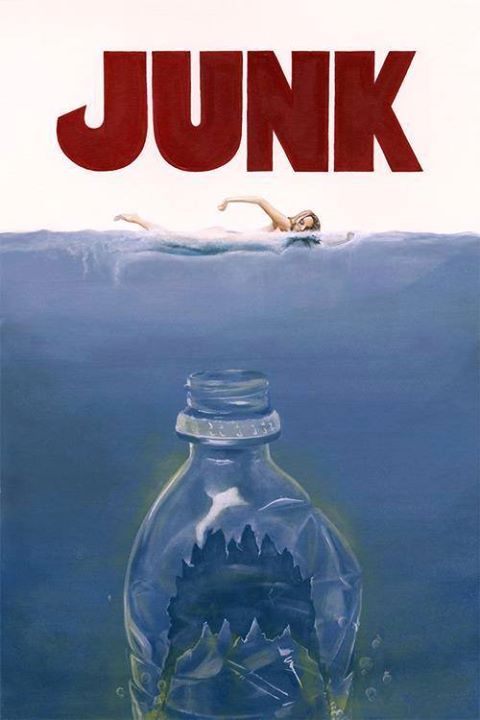
The Most Versatile Movie Poster Ever

Bull shark populations have declined up to 90% from finning pressures. You can donate as little as $10 and get various perks: a shout-out on Twitter or FB,

Bull shark (Photo credit: Wikipedia)
a personalized certificate all the way up to an autographed vintage JAWS t-shirt.
Click here to adopt!
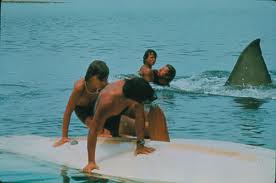
Deemed too gruesome for the final film, I’ve only glimpsed a bit of the original estuary scene in “The Making of Steven Spielberg’s Jaws” doc available on the Jaws Anniversary DVD.
The hapless boy scout leader (played by stuntman Teddy Grossman) has fallen out of his little rowboat, been dragged under, lost an athletic (and still sneakered) leg. In the unedited version, we see him propelled by the shark, pushing Michael Brody out of harm’s way as the fish pushes him out to sea.
Excessive gore aside, I read somewhere that Grossman was a bit too hammy in this scene which could be another reason Spielberg axed it.
It’s still my favorite part in the movie, even its edited form–the, sweet oblivious Grossman (“Hey, you guys need any help?) trying to tell the boys how to tie a knot while the fin speeds toward him is full of pathos and terror.
I remember staring at a photo included in the JAWS log, (a childhood bible of sorts), that showed Grossman with blood pouring out of his mouth as thick and dark as chocolate syrup, his eyes cast back at that towering fin escorting him to oblivion. There’s something weirdly religious about the martyrdom and the blood in this scene–the Christian sacrifice in the mouth of the pagan God.
Photos by Lisa Stone
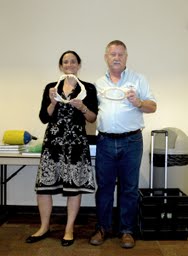
I am still ecstatic from Ralph Collier’s lecture this afternoon at Glendale College this afternoon. Great turn out–students, teachers from all disciplines, and people from outside school–including one dazzled shark nerd in a Jaws t-shirt who sat in the front row, and my dear friend Lisa and her fellow shark fanatic pal, Jack.
Ralph covered some fascinating stuff about shark behavior including “spy hopping” in which white sharks (and apparently oceanic white tips) stick their heads out of the water to check out what’s happening on land and sometimes startle random seals off the edges of rookeries. They also spy hop to calculate which group of seals in the haul-out area might be easiest to sweep into the water via a giant breach. Essentially, I learned that white sharks ain’t dummies. Not by a long shot. They have memories. They make calculated decisions. Ralph doesn’t believe in calling shark encounters “accidents”–he gives the animals volition—whether the intent is to investigate or to launch a predatory strike.
I learned two more disturbing consequences of shark finning:
1. When the discarded bodies of finned sharks are thrown overboard, they sink to the bottom where ammonia leaking from their ravaged bodies destroys coral communities.
2. Increasing numbers of people in Asia who consume shark fin soup are developing neurodegenerative diseases including Alzheimer’s, Parkinson’s, and A.L.S. Researchers have proposed that the high concentrations of mercury in shark fin and flesh bind with other neurotoxins and create a lethal toxic compound. Could this new health concern become a powerful force in stopping finning?
Writing the introduction to Ralph Collier’s lecture tomorrow. This man knows everything about white sharks from their interactions with people to their inspections of inanimate objects and sea birds. He was the first to notice how white sharks roll their eyes during predatory or investigative attacks. The Egyptian Government asked for his help after a series of attacks in the Red Sea in 2010. He’s appeared in 50 documentaries, his work cited in over 300 publications. He’s written stuff on white shark dietary habits, and how they see colors and respond to sound.
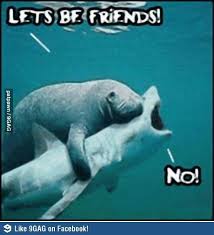
It is a fascinating thing—the devotion of one’s entire life to understand the behavior of such an alien creature…. I wonder how one might compare this obsession with sharks to the obsessive drive of the artist? It’s a question that I’m frankly too tired to contemplate, so here’s a meme:
After “Sharkwater” ended, I talked with my students about Paul Watson’s remark that major social change always begin with a handful of people, not a miraculous awakening of the masses. “I think we need to do more than protest, though,” a student remarked wistfully. I agreed. She’d pinpointed a restlessness in me to start something, to go beyond teaching–although today this section, which had felt a bit stilted, became a bit more alive.
“Why don’t classes talk more about things like this?” another student asked. “Things” like the fact that we are living through a mass extinction. On the way out, a young woman asked for advice: she had to give an informative speech. Should she talk about Sea Shepherd’s mission or the plight of sharks? As they gathered their books I overheard a few others talking “Have you seen “Blackfish”? It’s really sad.” I liked that they were talking. Sadness is a beginning. Anger is a beginning.
After the class had ended, I thought about how sharks have shaped the evolution of other animals in the sea, and how they have shaped my evolution as well. Fear and charisma. I think my students would find me weird or sentimental for saying so, but sharks are to me like strange, ancient Gods.
And what should we call the brutality and waste of shark finning but a mortal sin?

When my dive group arrived at Ventura Harbor, ambling down the ramp to the docked boat, we noticed this slumbering, adorable, blubberous sea lion stretched out on the edge of the dock, his eyes glittering in the dark.
We headed out in the morning, the ocean impossibly blue, but so rough I spent most of the ride out in the bunk down below deck, escaping the rollicking Pacific by reading an old copy of the Atlantic Monthly which luckily for me had both an article on Sylvia Plath and one on The Beatles. I tried earnestly not to throw up and succeeded. When I did return to the deck, I learned I’d missed a pod of dolphins frolicking near the boat, but sea birds were flying close, reminding me of a trip to Channel Islands many years before, with my friend Dan and his father Richard. An expert birder, Richard had switched his obsession to butterflies and had come to the Islands to try and spot one. As Tim O’Brien once said, “odd fragments stick to memory” and I recall that Richard told me there was technically no such thing as a seagull.
Dan and I lost our fathers months apart last year. Before I’d come to the dive boat, I’d had a difficult afternoon. As a writer, your material is your own life and every word I wrote, summoned my father and confirm his absence. But I tried to exert some control on the flood of memories as I stepped on the dive boat. I didn’t want to be distracted by some melancholy image of a birch tree or a pasture and end up dead, tangled in a kelp forest. Continue reading
Decayed. Abandoned. Immortal
A literary journal of safety and danger
Today's News, Yesterday's History
The daily musings of a writer.
News and images from The Forbidden Kingdom, opening in the US April 18, 2008
4 out of 5 dentists recommend this WordPress.com site
Because we don't have the luxury of being single-issue
Essays on Creative Nonfiction
A Creative Camera Club Inspiring people to take photographs
Writer, Reader, Kind of Spritely Looking
Historic Hollywood and Southern California Architecture, History, People and Travel by Steve Vaught
Forget Hunters' Feeble Rationalizations and Trust Your Gut Feelings: Making Sport of Killing Is Not Healthy Human Behavior
DEENA METZGER'S BLOG
This is where Island Radio 88.7 FM podcasts - and more...
Smart and surprising
Critique Collective is your source for information and interviews about emerging and established contemporary artists.
A daily dose of funny videos
Speaking for those with no voice~
outsider publishing from 2011 to 2015
 Shark Dreams