Day 101 10/4/13: Five Things I Learned at the Marine Mammal Center

Image

1. The pinnipeds arriving at the San Pedro rarely suffer from shark bites. The Center’s marine biologist, Chris Nagel has seen about three shark bites in five years. Most of these bites involve a stripping off of the skin. As I mentioned about a million blog posts ago, the Center treats shark bites (quite successfully) with special bacteria-free honey from South America and…duct tape.

2. The seals and sea-lion patients do suffer from marine mites, a variety of bacterial infections, and injuries inflicted by people. These include gunshots to the face, being tossed mackerel stuffed with dynamite and having their flippers hacked off by angry fishermen. Dead seals have also been found with algae-covered plastic water bottles in their guts. The most common ailment the animals suffer from–dehydration–is also indirectly, human-caused. Pinnipeds get their water from fish. Rising surface temperatures drive fish to the cooler depths. As the immature seals don’t know how to dive very deeply, they either can’t find fish, or depend on their mothers who must then go on deeper, and often longer hunts and don’t always return with food or return at all.

3. Anti-evolutionists often protest at the MMC. Even though they don’t believe in evolution, these activists express outrage that the Center “wastes” money to nurse sick and wounded animals back to health rather than “relying on natural selection.” I know, I know.

4. Some of the marine mammals that aren’t able to return to the wild, ” join” the Navy. The seals work for the military as search and rescue animals. They carry tools and identify foreign divers. Smart and cooperative, the slippery charmers are also highly social animals and rarely go AWOL. Porpoises however, are higher maintenance, and so often dubbed “The Lindsay Lohans” of the sea. The idea of drafting animals into military service makes me feel very weird.

5. Harbor seals, those spotted little darlings whose plush effigies populate aquarium gift shops everywhere, are actually really, really mean. Fur seals are also pretty cantankerous and are never returned to the ocean in popular swimming or surf spots, where they would likely bite people, but instead are transported about 40 miles out on the ocean before they’re set free.

Day 97 9/30/13: Thinking Like An Animal

Nearly busted with pride when a student who’d done the extra credit assignment on “Blackfish” told me she was going to a protest at SeaWorld in October.  She felt a little cautious. “My friends said people get arrested there.”  I reassured her about not ending up in the slammer, but I hope she doesn’t get turned off by any weirdos.  Last year, another young attractive student of mine attended her first “Fur-Free Friday” in Beverly Hills. She had a great time, aside from “this old creepy vegan guy” hitting on her. Gross.

All the day’s teaching blurs into one extended conversation on animal consciousness with a few diversions into fragments and run-ons. We discussed a great essay called “Fear in the Shape of a Fish” about, among many other things, shark attacks in Hawaii and the clash between the native people for whom the shark represents an ancestor spirit and the hired shark hunters. The writer (forgot her name, the book is in the car) investigates her own “intellectual sympathy” with the sharks as well as her fear, which she ultimately transcends without ever sacrificing her awe at the mystery of these fish, and the impossibility of any shaman, hunter or scientist of ever really knowing their true nature.

Presentation Mindmap: Networked Consciousness

Presentation Mindmap: Networked Consciousness (Photo credit: inju)

In another class, in another school, taught an essay about animal consciousness called “Cats, Bats, Crickets and Chaos” by Lewis Thomas.  I asked the class to meditate to appreciate the “wisdom of emptiness” that Lewis discusses–the no-thought-enlightenment that humans can hardly ever attain and animals probably achieve just by being.

One shy, smart kid in the corner totally got it: “I went into a trance,” he said. For many of them five minutes of stillness was unbearable, they laughed or didn’t even close their eyes.  I grew impatient and found myself scolding students for saying things like “I can only meditate in the mountains or at the beach.”

The more I lectured them (in reality only a minute or two), the more coarse and human I became. Gone was the fleeting bliss of no thought, my tenuous link to animal consciousness. I felt as alienated from the reality of nature as the wizened vegan trying to coax the lovely college girl into bed by appealing to her compassion for helpless animals.  Gross.

Day 91 9/24/13: Ralph Collier’s Awesome Resume

Writing the introduction to Ralph Collier’s lecture tomorrow. This man knows everything about white sharks from their interactions with people to their inspections of inanimate objects and sea birds. He was the first to notice how white sharks roll their eyes during predatory or investigative attacks. The Egyptian Government asked for his help after a series of attacks in the Red Sea in 2010. He’s appeared in 50 documentaries, his work cited in over 300 publications. He’s written stuff on white shark dietary habits, and how they see colors and respond to sound.

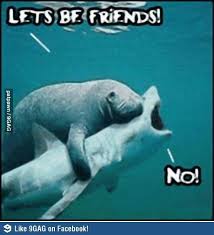
It is a fascinating thing—the devotion of one’s entire life to understand the behavior of such an alien creature…. I wonder how one might compare this obsession with sharks to the obsessive drive of the artist?   It’s a question that I’m frankly too tired to contemplate, so here’s a meme:

Codependent No More

Day 84 9/17/13: Teaching Mammals to Love Fish

A cavalcade of shark chores at school: plastering the joint with handsome sea-blue flyers advertising Ralph Collier’s lecture, xeroxing piles of articles,  realizing that not everyone is as utterly fascinated with all things shark as I am, although some students seem keen on learning more and one kind soul gave me a shark Pez dispenser.

I realize some of  this lack of interest in sharks is not just disguised fear, but disgust.  Sharks are fish. “Fish are gross,” one girl said. “They stink.” I thought of Jonathan Foer’s argument (I am too tired to reproduce it here) about fish being separated from us–living in the water they retain their otherness.

Another form of distance. Another barrier to overcome.

I described how beautiful the leopard sharks looked when I saw them in La Jolla, their spotted gold bodies rippling in the current. I gently suggested that our associations with smelly fish perhaps originated with the dead sea creatures laid out on slabs of ice in the market or languishing in filthy tanks.

I asked the class to write a few questions to ask Ralph Collier about shark behavior, attacks, etc.

A boy in the front row said, “I want to ask him if sharks have emotions.”

“Great question!” I exclaimed.

Although I felt too embarrassed to admit it, I’m still recovering from the crushing realization that this widely circulated shark-man love story was  a hoax.

Wood, iron nails, pigments

Day 83 9/16/13: Sand Tigers & Sex Ed

I marvel at how often discussions of animals illuminate human ignorance.

Why just today I was sharing this fascinating L.A. Times article on intrauterine cannibalism in sand tiger sharks with one of my classes. Although we’d already touched on this evolutionary oddity  (embryos chewing through womb walls to eat their sibling competitors),  I felt the subject deserved another go-round. I didn’t have much to add to the discussion except “Wow. Can you believe it?” until I neared the end of the piece and read this:

“In captivity, an alpha male sand tiger shark will guard a female when she shows signs that she will soon start ovulating.”

At various times in my illustrious career, I’ve been stunned by the dearth of knowledge that males between the ages of 19 and 25 have about female reproduction. Simply put, most guys in my classes have no idea what a period means. When I casually inquired if any males knew what ovulation meant, one fellow answered confidently, “When a girl has her period.” I made the sound of the losing game show buzzer. The girls giggled.

One young man finally explained eggs and fertility in an economical and tasteful way as his brethren looked on like hostages at the Lillith Faire.

I tried to lighten things up by asking the class to imagine if intrauterine cannibalism existed in humans.

I don’t think they quite get my particular brand of humor.

English: Sand Tiger Shark

English: Sand Tiger Shark (Photo credit: Wikipedia)

.

Day 79: 9/12/13: The Lonesome Death of Mr. Jaws

I wrote a letter to the New Yorker re: their recent piece “Cape Fear” which is largely about OCEARCH. I tried to keep it brief, mostly questioning why they use  brutal hook and haul methods, outdated tagging etc. Despite their current status as media darlings, I do believe people will eventually see the truth about OCEARCH’s shoddy science and macho spectacle.

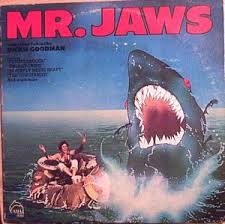
I also learned about the suicide of Dickie Goodman, the zany mastermind behind my well-worn and much loved 45 of “Mr. Jaws”  (#4 in 1975), not to mention earlier gems as “Energy Crisis ’74,” “Batman and his Grandmother” & “Frankentstein meets The Beatles.” Dickie shot himself back in 1989, but I didn’t find out until today when I decided to play a Youtube clip of “Mr. Jaws” for my baffled students. They laughed exactly once. “What IS this?” someone finally asked. Thank God they’d heard of Weird Al, so I could briefly outline the novelty record genre, although I just couldn’t summon the energy to explain K-Tel. Image

Day 76 9/9/13: Mourning, Millennials & Melodrama in “Jaws”

I had to remind myself to take a deep cleansing breath when I noticed a few of my students texting during “Jaws” today. Later, one of the guilty boys confessed the movie was “just too scary” and with the acute senses of a predatory fish (or a fellow neurotic), I detected residual fear in the shuffling way he gathered his books and hid his eyes behind a lank of  dark hair.

Several people laughed when the bereaved Mrs. Kintner slaps Chief Brody in the face for keeping the beaches open and letting her son Alex get chomped. Is this a kitschy moment? Perhaps. But I always found the scene too odd or mysterious to be pure melodrama. The black-veiled Mrs. Kintner is accompanied by a silent old man who might be her father or grandfather and the two of them progress in some odd inversion of a  wedding march toward Brody.

As Antonia Quirke noted in her BFI essay on “Jaws”: “She’s much older than the other mothers at the waterfront. This child was her last chance” (35). Quirke also notes that a slap in the movies normally stands in for sex, but “[t]o be slapped by Mrs. Kintner in mourning is like being kissed by a skeleton, it has that disquieting taboo mixed in” (36).

The book store ran out of my shark texts which may have explained this group’s lack of enthusiasm for uterine cannibalism or the ampullae of Lorenzini. So other than typing up a quick shark biology quiz, I’ve been checking in with the STOP OCEARCH activists. Sad to hear that the New Yorker did a story about OCEARCH (thanks for the tip, Connie), but pleased to know that a film exposing these charlatans (Price of Existence) and other marine exploitation is in the works. I’ll try to do what I can to help with the fundraising/consciousness raising for this project.

Day 72 9/5/13: The Past Tense

Today in shark class we marveled at the oddness of shark biology—the sand tigers’ practice of intrauterine cannibalism (unborn pups eat other embryos while still in the womb) and the unborn big eyed threshers that eat eggs from their mother’s uterus, a practice known as “oophagy.”  (I love the sound of that word–somewhere between “egg” and “oaf”).  We talked of Hawaiian and Aztec shark god myths and marveled at pictures of weird species like dwarf lanterns and goblin sharks.  I suggested we all convert to an ancient shark worshipping religion and walk around the campus in strange wooden masks.The class had the feeling of discovery and aimlessness that grade school classes used to have—“Oooo—look at this weird picture.” I guess my goal, if I had one, was immersion and delight.

I told the class that as a child I mourned the eclipse of “Jaws” reign by “Star Wars” in 1977. Since I lost my father last year, any mention of childhood summons him. My father was, after all, the person who took me to see “Jaws.”  Each memory threatens to pull me into  unknown depths. Even the well-worn stories are reframed by his absence.

Continue reading

Day 71: 9/4/13: The Shark Sees My Soul & Finds It Lacking

Section 2 of my shark class met today. Instead of trying to decipher their stony expressions (anxiety, indifference?), I let them write a page describing how they felt about the ocean. One girl told me about her fisherman father who is legally blind and makes his own hooks. Although she is a vegetarian, she respects that her father only catches a fish or two at a time, because it’s better than factory farming. Oh the sheltered bliss of youth! While her father may catch only a poor hapless specimen or two, she has yet to discover the “factory farming of the sea” that is industrial fishing.

Sifting through the narratives of fear of drowning, fear of plankton, joyful memories of the dolphins of Anacapa, I found one student that took an overnight trip to SeaWorld with her seventh grade science honors class and dissected a squid there, another who tried to overcome her fear of sharks by standing in the “shark tunnel” at the aforementioned aqua prison, but confessed, “I didn’t last more than a few seconds without tears rolling down my face. I just can’t face them.” (emphasis mine).

Besides turning every single one of my students against SeaWorld, I look forward to exploring their fear more deeply.

“I just can’t face them,” seems to endow sharks with the power not only to kill, but to see inside the human soul and detect some moral failing there. I thought cats alone possessed this ability.