This is extraordinary.

This is extraordinary.
Rare photos and other memorabilia from JAWS are hitting the auction block. I love these life jackets inscribed with the names of the actors.

I ALWAYS freak out when my obsessions collide. Especially The Beatles and JAWS. I nearly had a coronary a couple summers ago when I found a book of John Lennon’s drawings in which he’d scribbled a swimmer being chased by a huge black dorsal fin.
(Drawing circa 1976, waning JAWS era! I had always geeked out wondering how John would have felt watching JAWS when Richard Dreyfuss snaps at Quint: “I don’t need this working class hero crap.”)
Now, I stumbled on this unknown youtube visionary who has blended the ocean and radio and other sounds of the first scenes of JAWS with the Beatles Revolution 9, and some piece of John Lennon audio which, I admit I can’t readily tie to an interview.
(Is he talking about A Hard Day’s Night or Let it Be?)
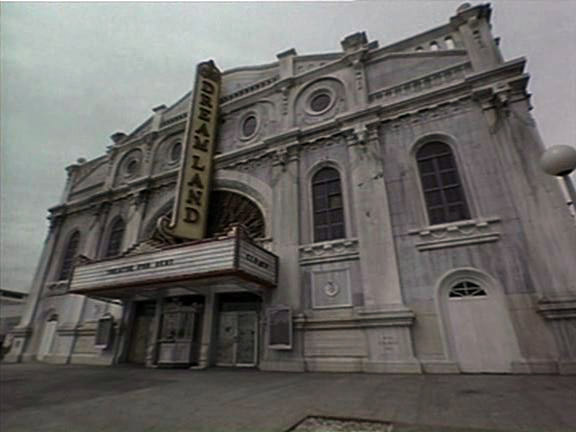 If you like poetry, sign up for the Academy of American Poets’ Poem-a-Day e-mail. It’s pretty great. I loved today’s poem by Albert Rios. It reminded me of the first time I saw “Jaws” and how all the cigarette smoke rose from the front row creating wraiths of fog around the screen.
When There Were Ghosts
On the Mexico side in the 1950s and 60s,
There were movie houses everywhere
And for the longest time people could smoke
As they pleased in the comfort of the theaters.
The smoke rose and the movie told itself
On the screen and in the air both,
The projection caught a little
In the wavering mist of the cigarettes.
In this way, every story was two stories
And every character lived near its ghost.
Looking up we knew what would happen next
Before it did, as if it the movie were dreaming
Itself, and we were part of it, part of the plot
Itself, and not just the audience.
And in that dream the actors’ faces bent
A little, hard to make out exactly in the smoke,
So that María Félix and Pedro Armendáriz
Looked a little like my aunt and one of my uncles–
And so they were, and so were we all in the movies,
Which is how I remember it: Popcorn in hand,
Smoke in the air, gum on the floor–
Those Saturday nights, we ourselves
Were the story and the stuff and the stars.
We ourselves were alive in the dance of the dream.
This is a poem by Robert Frost called “Directive.”
Back out of all this now too much for us,
Back in a time made simple by the loss
Of detail, burned, dissolved, and broken off
Like graveyard marble sculpture in the weather,
There is a house that is no more a house
Upon a farm that is no more a farm
And in a town that is no more a town.
The road there, if you’ll let a guide direct you
Who only has at heart your getting lost,
May seem as if it should have been a quarry—
Great monolithic knees the former town
Long since gave up pretense of keeping covered.
And there’s a story in a book about it:
Besides the wear of iron wagon wheels
The ledges show lines ruled southeast-northwest,
The chisel work of an enormous Glacier
That braced his feet against the Arctic Pole.
You must not mind a certain coolness from him
Still said to haunt this side of Panther Mountain.
Nor need you mind the serial ordeal
Of being watched from forty cellar holes
As if by eye pairs out of forty firkins.
As for the woods’ excitement over you
That sends light rustle rushes to their leaves,
Charge that to upstart inexperience.
Where were they all not twenty years ago?
They think too much of having shaded out
A few old pecker-fretted apple trees.
Make yourself up a cheering song of how
Someone’s road home from work this once was,
Who may be just ahead of you on foot
Or creaking with a buggy load of grain.
The height of the adventure is the height
Of country where two village cultures faded
Into each other. Both of them are lost.
And if you’re lost enough to find yourself
By now, pull in your ladder road behind you
And put a sign up CLOSED to all but me.
Then make yourself at home. The only field
Now left’s no bigger than a harness gall.
First there’s the children’s house of make-believe,
Some shattered dishes underneath a pine,
The playthings in the playhouse of the children.
Weep for what little things could make them glad.
Then for the house that is no more a house,
But only a belilaced cellar hole,
Now slowly closing like a dent in dough.
This was no playhouse but a house in earnest.
Your destination and your destiny’s
A brook that was the water of the house,
Cold as a spring as yet so near its source,
Too lofty and original to rage.
(We know the valley streams that when aroused
Will leave their tatters hung on barb and thorn.)
I have kept hidden in the instep arch
Of an old cedar at the waterside
A broken drinking goblet like the Grail
Under a spell so the wrong ones can’t find it,
So can’t get saved, as Saint Mark says they mustn’t.
(I stole the goblet from the children’s playhouse.)
Here are your waters and your watering place.
Drink and be whole again beyond confusion.
I really like that this piece by Lily Williams addresses the horror of shark finning and its consequences and somehow manages to be playful.
(Thanks for finding this Ani!)

Some truths we think we know. Then we actually live them. For me, one such truth is: “All places exist in the body.” I first fell in love with this concept in 1995 at U.C. Berkeley when a poetry teacher of mine mentioned it.
In the class, I wrote a short piece about a guy I’d been absolutely nuts about when I was very young—this poem was economical, but full of dreamy sensuality and ribs rising, and concluded with a kind of hazy philosophizing that nothing was really lost if “all things exist in the body.” I changed “places” to “things” thinking there was really no difference.
But I didn’t know then that remembering with the body means more than a breathless nostalgic lust, or the addled mind throwing the mostly forgotten body a bone.
All places exist in the body. The distinction matters.
When my father died, leaving the house I had known and loved and returned to for 44 years to his mentally unbalanced wife, I became an exile. We’re all exiles. We were born exiles, after all. But we live here a while and we forget. Then someone dies or the door forever closes on some beloved place.
I learned that losing a place does not feel the same as losing a person. And while I know better than to apply linear timelines to grief, when the initial shock and frequent, exhausting crying jags over my father subsided, the house, the fields, the woods moved in.
They took residence in my body in a way that memories of the dead never have. The opposite of an exorcism, a new settling began. I now understood that properly remembered, a well was also a throat, that doors were breasts, that the lifting of old latches, the bark of disappeared trees, all the obscure pleasures of warm mud and cold stone had to have some place to go. But not to become projections–the ever-thinning, forever looping films of the mind. These things had to go where they could grow, a place where all the restless spirits of habit could find their place.
This kind of remembering, this very physical presence that aligns the outside with the inside, so much that teeth take on the silent weight of stone walls, this kind of memory-as-occupation feels at times almost supernatural. I tried to tame it with a poem:
A moon-bright field raises hairs on the arms.
Wrists go numb remembering dark brooks.
Horses become instinct, thirst.
What it can no longer return to
in the old way, the body rebuilds, reclaims
as if to say: there was always only here.
Is this wholeness at last?
The translation of all loved things
to their essence
The barn less brick
than silence that agreed for a time
to gather itself into manger and beam
The poem ends, but the house still shows up. What does it want of me? There is no danger of forgetting.
Maybe only a simple transmission of information, the declaration of an obscure fact:
On the cellar walls, long ago strangers recorded snowfalls in soft pencil, along with recipes for elderberry wine. We added to these our own statistics of startling snowfalls, how much fell, how little stayed. In the barn, the births and deaths of horses are written in blue on the inside door of a hay strewn cupboard.
I don’t know what this means. Carried in the body, it no longer even feels like a memory, just a code that if finally broken, might save someone else.
 I met Carmen Einfinger in New York in the summer of 1996. Carmen is a wild painter, a genius of color. That summer I spent many afternoons in the small East Village apartment Carmen shared with her filmmaker boyfriend while Carmen painted my portrait. In the end, I became yellow, red, green and orange and very tall.
In between posing, Carmen and I went to art shows and ate great food. Carmen told me about séances she’d attended as a child in Brazil. We talked a lot about painting. We listened to John Moran’s “The Manson Family: An Opera.”
In short, we had a blast.
Recently, Carmen took a trip to Tahiti, which inspired some amazing work. When I saw her ink and paper piece, “The Man Who Loved Looking at Sharks and Then Became One,” I knew I had to share it here. I loved the drawing, and the title sounded like the invention of a new myth. Carmen wrote to me about her creative process:
These images I do in my daily sketchbook come from a place of “this child” in me.
When I was young, my father was gone.
My mother was not around.
I was a child, but not this child.
This child now creates images from that lost place.
However, as much as these drawings are an expression of my lost child, they also are an expression of a lifetime of cultural and artistic development.
I believe that we have our own personal and a collective history. We keep imprints in our bodies from all our existences.
In the collective unconscious, these emotions express themselves as universal symbols creating then the universality of human emotions.
My image “The Man Who Loved Looking at Sharks and then Became One….” is a symbol for what we fear, expressed through the child in its purest primal unconscious state. The man who loves looking at sharks is aware of the danger: the shark could eat him up emotionally or physically. In order to avoid this, he must become a shark, so that he can eat the shark instead of being eaten. The child here speaks of the darker side of the shark, the one he fears.
If we are lucky and are able to live our lives without becoming fragmented, we can connect with this primal existence as many times as we wish.
I discovered this through my creativity.
 Leopard sharks will always have a place in my heart because they are the first shark I ever saw in the ocean and I swear one raised her head from of those sad “petting” tanks at the Santa Monica Aquarium and looked straight at me once.
Anyway, they’re shy and gorgeous and swimming in the canals of Venice, California.
( Thanks Brandy, for this bit of good news)
P.S. While trying to find the link to the story, I stumbled on yet another bad shark movie: Sharks in Venice (Italy, of course) starring Stephen Baldwin.
 Human beings never cease to completely baffle me.
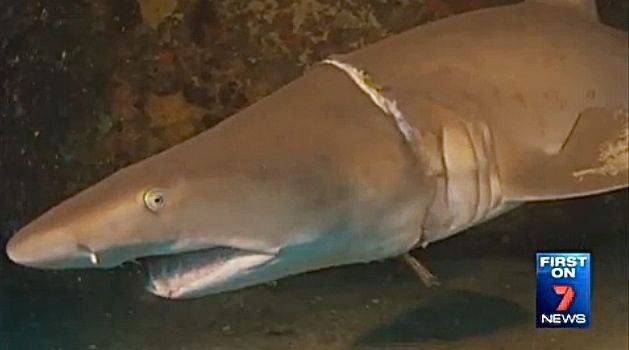
In Australia, tiger sharks are being hooked, drown and shot as part of an ineffective “cull” program, while in the same waters divers and veterinarians collaborate in an elaborate attempt to save this grey nurse shark from being suffocated by a piece of plastic wound tightly around its neck.
(Tip of the fin to Connie for sending this one!)
Decayed. Abandoned. Immortal
A literary journal of safety and danger
Today's News, Yesterday's History
The daily musings of a writer.
News and images from The Forbidden Kingdom, opening in the US April 18, 2008
4 out of 5 dentists recommend this WordPress.com site
Because we don't have the luxury of being single-issue
Essays on Creative Nonfiction
A Creative Camera Club Inspiring people to take photographs
Writer, Reader, Kind of Spritely Looking
Historic Hollywood and Southern California Architecture, History, People and Travel by Steve Vaught
Forget Hunters' Feeble Rationalizations and Trust Your Gut Feelings: Making Sport of Killing Is Not Healthy Human Behavior
DEENA METZGER'S BLOG
This is where Island Radio 88.7 FM podcasts - and more...
Smart and surprising
Critique Collective is your source for information and interviews about emerging and established contemporary artists.
A daily dose of funny videos
Speaking for those with no voice~
outsider publishing from 2011 to 2015
 Shark Dreams