
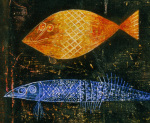
Day 165 12/7/13: Great Shark Paintings Vol. 5 “Shark King” by Sam Georgieff

 Now that my shark class is winding down, now that we’ve discussed the threat of overfishing and the horrors of finning, now that we’ve explicated “The Shark” by Mary Oliver and written about how power pivots on the ability to speak, now that we’ve learned about the wondrous diversity of sharks, their hidden traditions (intrauterine cannibalism) and their supernatural senses, I’ve rounded out the semester with readings about the importance of awareness (David Foster Wallace’s brilliant Kenyon Commencement Address) and action (Derrick Jensen’s Loaded Words: Writing as a Combat Discipline).
I am hoping to plant seeds—something that might take root and grow beyond the boundaries of the classroom. Don’t forget about the natural world. Be present. Get out of yourself. Try to be of service.
I thought I had better follow my own advice and go walking in Los Angeles on an afternoon at the end of the year. The light looked almost stormy streaming from robust clouds, random in its distribution of illumination and shadow. I decided to walk toward a less-traveled neighborhood, near the newly converted Kadampa Meditation Center where I went to meditate the other night, remembering once how I’d almost rented an apartment near there in an old Spanish building with a ship for a weathervane, hallways full of antiques, and, the landlord revealed with a degree of pride, a ghost.
It’s so interesting that the same street can live multiple lives in the same city—Palmerston, Alexandria, Kenmore—to walk these streets north of Franklin is a different world than their southern extremities. I paused at the Kadampa Center; the formerly Christian church where the burning thorn pierced heart in the stained glass window has been replaced with a lotus flower, and then headed north on Palmerston. I love to look at architecture in Los Angeles. I love the curving, quiet streets where houses can’t make up their minds, yet the incongruities are somehow awkwardly resolved—the Spanish roof sheltering a porch of Corinthian columns. The green shingled house with the curving storybook path. My head felt like a camera that pans, reveals. All I wanted was to walk deeper into a place I did not know, past rambling brick houses with dark Tudor windows whose solemnity is relieved by the reflection of manicured grass.
Climbing a hill, I noticed Christmas lights emitting a steady, secret glow from a blasé hedge while above, on an overhead branch, a Halloween skeleton floated in the breeze—clearly articulated “life-like” skull, skinny mummy arms, and a body that ended abruptly in streaming burlap rags. The arms were wide and fleshless palms open. I’d seen pictures of Jesus in that same attitude of supplication. This skeleton, streaming like a flag in the sudden breeze, naked skull limned with golden light, appeared to be preaching, perhaps to the rosebushes.
I love California, but my early Northeastern life has structured and nurtured my deepest responses to nature. I find myself always drawn to those houses shrouded in tall, green trees because they remind me of the places (once real now memory) that I am afraid to return to, fearing that great undertow of memory will sweep me out to sea. Today I found one such place. The green trees (tall, tall-evergreen and deciduous) seemed less brooding than expectant. When I peered over the curved iron gate, I noticed a half-hidden house. A modest pale green turret with narrow windows, felt monastic, regal and I flashed on the uneven shards of colored glass on the cover of the St. Patrick’s missalette I left on an empty pew a thousand Christmas Eves ago.
But I couldn’t feel sad. I had no need for remembering when everything felt so generous and alive, the trees rising up from the ground dotted with eyeholes, and the sudden blue and white of a house like a bright postcard from Santorini. I thought: Everything keeps changing shape—the streets curve, the houses assume their forms and postures, the tree roots declare themselves busting through the concrete. The memories of all the places that we can never return to, grow like living things in the body, their roofs push at the ribs, their fields unfold, erasing thought.
I kept waiting for the spell to break. Surely all would dissolve into quotidian reality as the light changed. Yet even as I headed back toward Franklin, past all the apartments and vintage stores turned invisible from being endlessly seen, even as I cursed the errant plastic bag skittering across Vermont Avenue, there by the 7-11, in the rounded nest-shaped bush next to the bus stop, a dozen or more little brown and white birds popped out of the hollows between the branches, all chattering at once, all looking at me. Don’t just survive here, the birds told me sing, sing.
This wonderful short film of Max Ernst working with natural materials in his studio is a true inspiration. Thanks to the always interesting l biblioklept blog for this!
I have waited my entire life to see a dorsal fin rise from the surface in the tidal zone.
I love the curious dogs running toward the water, and the way that dark fin just disappears into the chop and chaos of the ocean.
Oh Beauty! Oh Mystery of Life!
“Dreams are the finest entertainment known…and given rag-cheap—-” Robert Graves
I really need to re-learn the art of dreaming. The nights are too often voids, although sometimes I do wake up remembering an odd phrase or a fragment of a practical plan. I am grateful for these scraps like an amnesiac indebted to a kind stranger with a newspaper clipping that documents the fateful car crash, the scandal, the glorious career as a concert pianist–the world before forgetting. When I wake up, I want some talisman, some proof that I’ve traveled there and come back–wherever there is.
When I do remember a dream, it seems the plots are simpler—even if the dreams are strange. Here is a simple one:
I am walking down a road. I find a gray nest. I understand immediately what this means. I pick up the nest. I keep walking into the end of the dream.
But there was a golden age of dreaming–several golden ages in fact. One such age was a three-year period during graduate school. I read so much, and such an incredible variety of texts, that my dreams were ready-made stories or poems, or commentaries. I collected old oversized ledgers from antique stores all over the Northeast. I filled them with dreams. Nature dreams. Celebrity dreams. Once or twice I believe I crossed into the land of the dead. Nothing grand. Nothing scary. But a small empty house with a sliding glass door next to a dreamy, blurry wetland lit with fireflies. One by one the cats I’d lost showed up, rubbing against doorways, weaving around my legs.
Dreams recurred like obscure TV shows on late night snowy channels. Small mountain towns with haunted houses. I knew the roads that I had to take to get there. I welcomed the worn and familiar plots, the history behind the room with the four poster bed.
And of course, I dreamed of sharks. So many dark seas! So many Freudian wish fulfillments–seeing a dorsal fin rise just beyond the tidal line. A great white eyeing me with a steadiness too familiar to be pure malice.
I try to go back there. Sometimes reading just before bed does the trick. If I read Ted Hughes’ “Tales from Ovid,” I dream weird, frantic things an anthropologist’s home movie–a man dressed like a bird dancing and flapping his arm wings. If I read prose, I emerge from eight hours of unconsciousness with a vague armature of a narrative that quickly dissolves in the daylight.
Maybe a couple times a year, I will have a dream that is more than a dream. These dreams are vivid. They are strange and familiar. I remember them with great fidelity to detail. But to write more about these dreams might jinx them, prevent the capricious dream gods from ever sending me another.
Sleep without clothes. Abstain from the internet. Eat spicy food. Write down whatever fragments no matter how ephemeral, any residual impressions. What else can I do to encourage dreaming? I cannot lose my double life. There is something there that keeps me sane. Its chaos and jagged images, feel like the restoration of an essential order. Have I grown too old? Is my waking life too dull? What have I done to lose that elusive passport?
Maybe it’s time to pull out the old ledgers & read the old dreams. Maybe the clues are there, maybe I can find some sort of map.

English: Lubok-style cover of a Russian dream book. The book is solemnly named The Dream-Book, or an Interpretation of Dreams by Sundry Egyptian and Indian Savants and Astronomers. (Photo credit: Wikipedia)
I admit, I stole the title of this post from a Raymond Carver story, but it is a small, but good thing to sign this petition.
We must change the way we’re trawling, long-lining, overfishing and otherwise indiscriminately pillaging the oceans before it’s too late. In other words, Really. Soon.
Please take a small step by signing this petition against industrialized fishing.
The sharks & other finned, gilled, tentacled, shelled, gelatinous and microscopic creatures of the deep send their deepest thanks.
Related articles
 10 Alarming Facts About Overfishing (onegreenplanet.org)

Danial Ryan’s sweet and sour surrealism is where it’s at! Sharks, sloths, cats, bears and all your other favorite mammals & pop culture idols are reborn with dark humor & panache on Ryan’s canvases. Best of all, you can own an original Danial Ryan masterwork for as little as $10. Click on the lovestruck white sharks to check out Ryan’s available art!


Sea Shepherd Conservation Society (Photo credit: Wikipedia)
It’s true. Sharks could be extinct in 30 years.
Some populations may disappear within a decade.
For the last three years, Sea Shepherd has been working on a documentary in collaboration with the union of environmental lawyers in Latin America to help educate the environmental legal community. This film is the first of its kind designed to educate and inspire environmental prosecutors.We need to not only to create tougher shark finning laws, but to make sure that they’re enforced. We need to keep marine sanctuaries safe from illegal finning and get tougher convictions for ocean-related crimes.
This is is such a good cause, and you can be a part of it for as little as $1.00!
Decayed. Abandoned. Immortal
A literary journal of safety and danger
Today's News, Yesterday's History
The daily musings of a writer.
News and images from The Forbidden Kingdom, opening in the US April 18, 2008
4 out of 5 dentists recommend this WordPress.com site
Because we don't have the luxury of being single-issue
Essays on Creative Nonfiction
A Creative Camera Club Inspiring people to take photographs
Writer, Reader, Kind of Spritely Looking
Historic Hollywood and Southern California Architecture, History, People and Travel by Steve Vaught
Forget Hunters' Feeble Rationalizations and Trust Your Gut Feelings: Making Sport of Killing Is Not Healthy Human Behavior
DEENA METZGER'S BLOG
This is where Island Radio 88.7 FM podcasts - and more...
Smart and surprising
Critique Collective is your source for information and interviews about emerging and established contemporary artists.
A daily dose of funny videos
Speaking for those with no voice~
outsider publishing from 2011 to 2015

 Shark Dreams