Day 130 11/2/13: How To Tell A True Shark Story

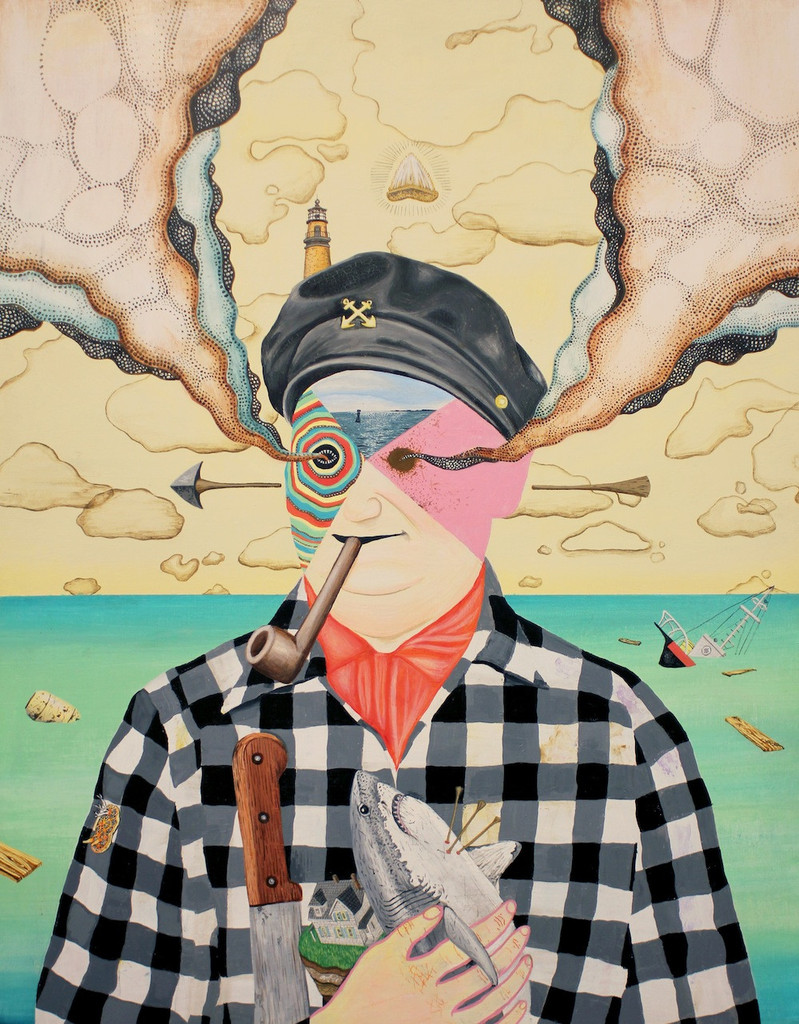
What a fabulous night of art, conversation and all things shark at the Hero Complex Gallery. My favorite pieces in the very Quint-centric (not a criticism) JAWS-tribute art show, were those that riffed on the movie’s less well-worn lines (although all of the dialogue is threadbare if you’re a JAWS geek), and its unforgettable, but only briefly glimpsed faces.  Aaron Glasson’s “The Harbormaster,” is a psychotropic take on that smiling old salt who emerges, pipe-clenched-firmly-in-teeth from a dockside shed, an oasis of eccentric calm amid the rabid, reward-hungry shark hunters and then is gone.

Gorgeous Jaws-themed cookies, a fascinating presentation by Jaws production designer Joe Alves, insanely life-like replicas of Hooper, Quint and Brody and Ben Gardener’s head. “Smile You Son of a Bitch” closes Nov. 3.  If you live in L.A. and love JAWS or sharks, please go and support the show. You can buy some great art for as little as $20 and support Pangeaseed’s shark conservation efforts.

As transcendently JAWS-geeky as the evening was, the true highlight for me came afterwards when my friends and I were lucky enough to have dinner with Ralph and Cindy Collier and talk sharks and drink wine and eat very late into the evening. The waitresses seemed to linger and eavesdrop as Ralph told stories of unlucky abalone divers of mysterious tooth fragments. I’m delighted and surprised by the ease with which Ralph dismantles myths and clichés about shark behavior. He patiently answered my questions about stories that have long haunted me like the 1959  attack on skin diver Robert Pamperin whose body was never found.  Such cases often support the theory that sharks “eat people,” that the hapless souls disappear down the ravenous shark’s gullet.  But according to Ralph, studies of tides and currents offer a more realistic possibility– the remains are often carried or pulled out into the oblivion of the deep sea.

In “The Things They Carried,” Tim O’Brien writes that war stories are never really about war. “They’re about friendship. Sunlight.”  I would argue that shark stories are also mystery stories about what it means to be animal and human and that like O’Brien’s Vietnam stories, even the true shark stories carry the deep dreamy resonance of myth, of nightmare, of the collision of worlds–human & animal, land & sea, tellable & untellable.
Image

Day 125 10/28/13: Remembering Lou Reed, Andy Warhol & An Old Horse

I wanted to write about the shark presentations my students gave, but most of them were lifeless recitations of Powerpoint slides, and I found myself thinking more about Lou Reed.

I played his music all last night.

What does it take to crack open the human heart? I don’t know why I’m surprised at my depth of feeling at Lou’s death.

Had I forgotten the heavy thrill of buying my first VU album, “White Light, White Heat,” of memorizing “The Gift”? How I used to keep a picture of Lou Reed in my photo album among images of my family? Why did I not even own this music I loved so much anymore? I’d memorized every song.

Between classes, I tried to lose my despair over the death of a major artist and the death of collective student imagination, in an essay about horses called “Partnering with Pegasus.”  Mares are the true leaders of the herds, not stallions.  I started thinking of 1992,  the last time I saw my childhood mare-ribsy and grizzled, 35 years old coming over the edge of a hill. She nickered when she spotted me, but I, shocked at her appearance, gasped.

Then we both froze staring at each other.

What a great surprise to find that horse standing in that field again.

The image hung there, and suddenly infusing that lost world was John Cale singing “The Style It Takes” a gentle song about Andy Warhol:

I’ll put the Empire State Building on your wall,

For 24 hours, glowing on your wall

Watch the sun rise above it in your room,

Wallpaper art, a great view…..

Did they always belong together this unlikely memory pair–an elderly horse and lonely Andy Warhol?

I started thinking of that well-worn Camus quote about having an infinite summer within. The places I’m afraid to return to, those fields, those songs (which are also places), are sites of renewal. Loss numbs and loss  surprises. Like music it wakes us up again to the dream of life.

Day 109: 10/12/13: Shark Coffins & Doomed Stuffed Animals

These innovative creations are a welcome break from correcting a batch of opaque papers on sharks and fear.

I like the spare yet surreal look of this art show, but I LOVE that it’s

happening in Shanghai!!

Check out Banksy’s “Sirens of the Lambs,” a sad and weird traveling piece on animals

slaughtered for food.

Image

Day 99 10/2/13: Ten Terrible Shark Jokes

Who knew there was such a genre?

Shark Jokes for the erudite:

Q: What was the shark;s favorite James Joyce novel
A: FINnegan’s Wake

Q: Who was the shark’s favorite Norwegian painter?
A: Edvard Munch!

Q: Who was the shark’s favorite 20th century art figure?
A: Marcel DuChomp

Here’s one for the scientific crowd:

Q: What do shark trees consist of?
A: Elasmobranches!

Film geeks might like these:

One of several versions of the painting "...

One of several versions of the painting “The Scream”. The National Gallery, Oslo, Norway. (Photo credit: Wikipedia)ally stupid:

Q: What is a sharks favorite Dustin Hoffman film?
A: Midnight Caudal

Q: Who is the shark communitys favorite 1950s film actress?
A: Dorsal Day

One for the playground:

Q: What is a sharks favorite kinda sandwich
A: Peanut butter and jellyfish!

Just stupid enough for me:

Q: Why aren’t there any shark puppeteers?
A: They have no hands!!

Q: Why did the mommy shark and daddy shark get divorced?
A: They no longer loved each other.

Q: What was the shark jazz musician’s favorite illegal substance?
A: Reefer!


Day 81 9/14/13: The Eternal Gift of the Michelin Man

More diving lessons today. Better. I didn’t feel like a helpless tumbling astronaut as much, though I was eternally vexed by the task of detaching  the connector hose to my BC underwater. And putting on a wetsuit still feels like skull-fucking the Michelin man. But I felt so peaceful snorkeling across the pool,  watching the glittering light patterns on the bottom, broad wavering bands of light like David Hockney’s swimming pool paintings.

Why is art so often my first way into nature?

I felt happy that I’d grown a little closer to becoming a better swimmer.  Crossing the pool wearing my lovely blue split fins it hardly felt like swimming at all.  And how strange that a deep-seated fear of sharks should lead me to something so pleasurable.

Writing about struggling with the wetsuit-as-Michelin-Man made me think of my sister Janet. I can’t really think of a single thing that Janet feared.  Truthfully, she often had a bit of contempt for those who let fear paralyze them.  Janet was pure fire,  such a force of nature, that it was inconceivable to me that she would ever die. Continue reading

Day 67 8/31/13: Sharks, Shame &Oral Fixations

Preparing for my shark class, I started feeling anxious. Will I strike the right balance between fun and conservation? Will I inspire any one of my students to actually do something about the oceans?Regretting my unfortunate choice of textbooks, I felt on the verge of falling into a major shame spiral about my skill as a teacher, which inspired a kind of greatest hits medley of degradation.

For example,  the familiar domino effect of paranoia and self-loathing I’ve often felt in the course of romantic love:

I fear you will notice my hopelessness at chess, sex, sports, trivia, cooking, dancing, and abandon me. Exposure of my inadequacy will then lead to exile from the larger community, which sensing my lack of fitness, will leave me to perish alone like a deformed animal.

Or something like that.

Sharks evoke a curiously liberating kind of fear—the ring of teeth, the lurid jaw and cavernous throat are primal, immediate. The horror of being consumed by a large fish doesn’t ignite the tedious chain of psychological causes and effects that the proximity of an intimate relationship does.

My first therapist Joyce, was not only a beautiful ex-model who collected Jasper Johns drawings, but an astute Jungian. I’d always had a rich dream life. Lucid dreams. Even premonitions. I told Joyce that I’d dreamed of sharks since childhood, hoping she might seamlessly link my dysfunctional family confessions with some deep-sea mythos of the subconscious.

Instead she stared at my ragged fingernails.

“Well, you’re very oral.”

I  took exhaustive notes during our sessions.  The pens I wrapped my ragged fingers around were invariably dotted with teeth indentations, the caps deformed and squashed by my clumsy molars. As a child I obsessively chewed free library bookmarks, cupcake papers and lollipop sticks to awkward mush balls, a habit that evoked both pleasure and shame.

At the time, I felt disappointed at Joyce’s spare, more Freudian than Jungian response, but over 23 years later I feel grateful to her. Instead of spinning a narrative about submerged anxieties stalking me until I faced them, Joyce aligned me with the powerful creatures I feared.

In some strange way, she made me one of them.

Day 56: 8/20/13: Art House Sharks

Spent the first half of the day dutifully studying dive manual and watching short YouTube films about positive buoyancy, proper fin selection, and how to clear a  flooded mask. In the afternoon I attended two movies: Museum Hours at the Royal and Cutie and the Boxer at the Nuart with my dear friend Helen. Both were great–Cutie and the Boxer is a documentary about two married artists—Ushio and Noriko Shinohara–and depicts the art life with all its perils, poverty and messy devotion. At one point, Ushio and Noriko are eating supper in their chaotic loft, talking about “Raiders of the Lost Ark,” and 80-year-old Ushio, an action-pop artist who paints with boxing gloves,  notes that  “Jaws” was Spielberg’s best film. While Noriko chastises her husband for his reactionary early work=best work credo, I had to agree with Ushio that Spielberg never topped “Jaws.”

Museum Hours is a meditation. It’s a movie about loneliness, life, death and relatable to anyone who has wandered around a strange city with very little money and become privy to all the ordinary alien miracles of empty urban spaces, the detritus of street markets, the odd beauty of trains at certain hours and the sanctuary of museums that both reflect and heighten the ordinary world. I loved seeing paintings fill an entire movie screen–scenes from Brueghel, beheaded Medusas,  ancient statues with sheared off noses.

I started imagining a new kind of shark movie–not a documentary or a silly exploitation film, but an art movie with winter light, museums and coffee.  Maybe a story about two dedicated shark researchers who lived together like artists, each with their own particular obsession–one devoted to lantern sharks and the other only caring about charismatic “man eaters” and their love threatens to illuminate or devour them at different points in the film. But in my art house picture, the sharks wouldn’t exist as  convenient metaphors for human frailty, beauty or power.  They would exist as subjects in their own right, filling the screen, so we might contemplate their mystery and gravity, as we gaze upon the statues of Gods with missing heads or wings.