Day 194 1/5/14: A Post-Christmas (Sort of) Fable

images-2The other day walking around the Hollywood Reservoir, I  discovered a tree covered in Christmas decorations. Two trees actually. “Festooned” with decorations might be pushing it, since this is January and as glittery it appeared, a tinge of belatedness vibrated at the edges. Large silver bells, flat stencil-style presents and glittery disco-style bulbs that are either silver or green and garland gold and ribsy. Everything shone in that I-don’t-recognize-the-meaning-of-January Los Angeles sun.

As I paused at the tree, some weird cocktail of juvenile delinquency and middle-aged nostalgia intoxicated me and I thought about stealing one of the silver disco balls. After all, it was Christmas and surely this tree had been decorated for a lark anyway and stealing was probably built into the design of a publicly decorated Christmas tree. But almost as soon as this impulse surfaced, like a good ex-Catholic, I immediately drown it in a tidal wave of shame and self-loathing.

Then I noticed the sign spinning and breathing among the ornaments. Handwritten and cardboard it said something like:

PLEASE DO NOT STEAL OUR ORNAMENTS. EACH ONE REPRESENTS SOMEONE WHO CAN NO LONGER WALK WITH US.

I’ve been trying to develop a more sophisticated version of God than “hypercritical eyeball that reads your every thought,” but this sign wasn’t helping.

As a kid, I read our Christmas tree like some annual, familiar, but always slightly altered text. The ornaments had specific histories, and their placement in the branches varied, and so the story they retold each year created slightly altered tones and new narrative possibilities. Only the nativity scene with its jagged broken donkey ear assumed the same position—perched on two barely developed branches near the trunk in the dark center of the tree. I always knew where it was, and yet my eye always came upon it as the surprised or lost child in a fable encounters a house in a primeval clearing.  The story I usually concocted had something to do with the proximity and juxtaposition of the holy and the kitschy–the baby Jesus bathed in the red and green light of the lights. On that outskirts of that sacred hollow, a Snoopy with antlers instead of beagle ears skated on an invisible pond.

We had had a tarnished silver disco ball on our Christmas trees in the 1970s, but my favorite ornament was the glass red Silent Night bulb with its white church steeple and its simple wave of snow. It reminded me of the words of another hymn—“The First Noel” and its cold winter’s night “that was so deep.” The line stuck with me long after midnight mass  because I could sense eternity in it. That a night could be deep made me reconsider darkness itself as it settled over our house and across our fields.  That sort of deep rolled like a storm cloud. It unfurled like a passage, wide and silent.

I suppose light has its own depth. The cardboard sign, somewhere between a plea and a warning framed itself in needles of light that jumped off the haphazard garland. It reflected me back at myself like the disco ball ornament I’d considered stealing. If I was living a myth (and who says I’m not?), my theft of the ornament would end in a haunting, my guilt fractured into a thousand spirit fragments in the  miniature mirrors of the disco ball that I’d hung it blithely on my rearview mirror. Distracted by its mocking, spinning death whirl, I might drive my car into a ditch and no one would know I’d died of a heart attack brought on my ghosts before internal injuries.

This is the season of the naked and the abandoned. The fallen.  Christmas trees haunt the alleys. I find the sight of these briefly coveted messengers of joy quite depressing. A tree if it is to be sacrificed, surely deserves to be an object of contemplation longer than the Christmas season or at least recycled to return in some fertilizing capacity to the earth. Passing these desolate trees on sidewalks, I feel their silent reproach. It’s as if I’m in church all over again: I died for you. There is something that sees hidden deep in those branches, something stolen from the pagan forest dragged inside and draped with new religion, then stripped again and forgotten.

I  like to imagine the tree on the edge of the Hollywood Reservoir still decorated in May or June, surprising those running or walking along the sandy shoulder of the road, the silver bells in the silent dry light of summer, the ragged breath of garland, the words lodged in its living branches.

Day 190 1/1/14: A Matter of Life and Death

For the second year in a row, I spent New Year’s Eve at a Buddhist mediation center with friends. This is a tradition that I never really consciously initiated, but one that I highly recommend. It is nice to enter a new year in the silence of meditation or following the rhythmic drone of prayer in a softly lit room while people are lighting fireworks or firing guns or generally acting like madmen in the dark outside.

The monk was funny. After talking about resolutions (regular flossing, fitness) and the power of the mind, he recommended a meditation that appealed to me: “I may die today.” “Or,” he said, looking out at the hundred or so people filling the tiny hall, “it’s likely that some of you might die this year. Not everyone will make it back here next New Year’s Eve.” This focus on death is designed to help us remember what’s important, which in Buddhism is resolving to become a better person and through this discovering some sort of peace which we can share with others.

Later Connie, Gail and talked about the countdown to my descent in the shark cage in South Africa in June. I made jokes about dying in the shark cage, because to joke about death is to at once acknowledge it and ward it off. It would be too perfect, too absurd for me to be eaten by a white shark when the whole point is to live to tell about it, to describe what it’s like to meet this old friend, this old fear, this dream human face to conical snout.What do their eyes look like, really? What’s the exact nature of their blackness, or up close are they really pure black at all?

Today I took down my brand new calendar and filled in all the numbered days until my shark trip, my uneven purple digits scrawled over the white space of unlived time, dwarfing the sensible preprinted numbers of the calendar. What are the odds, I wondered, that I won’t live until June? What is the numerical value of certainty or uncertainty?  I thought of the opening lines of Bob Dylan’s “Mississippi”: “Every step of the way/We walk the line/Your days are numbered/So are mine.” And I thought of my favorite piece of Buddhist scripture, “The Five Remembrances:”

I am of the nature to grow old.

There is no way to escape growing old.

I am of the nature to have ill-health.
There is no way to escape having ill-health.

I am of the nature to die.
There is no way to escape death.

All that is dear to me and everyone I love
are of the nature to change.
There is no way to escape being separated from them.

My actions are my only true belongings.
I cannot escape the consequences of my actions.
My actions are the ground on which I stand.

Sometimes I think that more difficult even than death itself (which promises, at least in my view, a degree of contentment, which brings with it the fulfillment of work that here remained unfinished, which is a state of perspective and unity), is the fourth remembrance.

Inescapable change, the separation from people and places, things that I am sometimes fooled into believing are permanent simply because they endure for twenty or forty years. Maybe later I will decide that the infirmity and indignity of old age is tougher, or that facing death whether it comes in the form of a shark, or dark, rapidly dividing cells, defies my attempts to tame it with philosophy. I don’t know.

But I do know that in a world in which everything dissolves and departs, we have to have some ballast, be it a prayer or tradition or the habit of matching every day with a number to make life feel at last, real to us.

English: Portrait of Allen Ginsberg and Bob Dy...

English: Portrait of Allen Ginsberg and Bob Dylan by Elsa Dorfman (1975) (Photo credit: Wikipen

Day 101 10/4/13: Five Things I Learned at the Marine Mammal Center

Image

1. The pinnipeds arriving at the San Pedro rarely suffer from shark bites. The Center’s marine biologist, Chris Nagel has seen about three shark bites in five years. Most of these bites involve a stripping off of the skin. As I mentioned about a million blog posts ago, the Center treats shark bites (quite successfully) with special bacteria-free honey from South America and…duct tape.

2. The seals and sea-lion patients do suffer from marine mites, a variety of bacterial infections, and injuries inflicted by people. These include gunshots to the face, being tossed mackerel stuffed with dynamite and having their flippers hacked off by angry fishermen. Dead seals have also been found with algae-covered plastic water bottles in their guts. The most common ailment the animals suffer from–dehydration–is also indirectly, human-caused. Pinnipeds get their water from fish. Rising surface temperatures drive fish to the cooler depths. As the immature seals don’t know how to dive very deeply, they either can’t find fish, or depend on their mothers who must then go on deeper, and often longer hunts and don’t always return with food or return at all.

3. Anti-evolutionists often protest at the MMC. Even though they don’t believe in evolution, these activists express outrage that the Center “wastes” money to nurse sick and wounded animals back to health rather than “relying on natural selection.” I know, I know.

4. Some of the marine mammals that aren’t able to return to the wild, ” join” the Navy. The seals work for the military as search and rescue animals. They carry tools and identify foreign divers. Smart and cooperative, the slippery charmers are also highly social animals and rarely go AWOL. Porpoises however, are higher maintenance, and so often dubbed “The Lindsay Lohans” of the sea. The idea of drafting animals into military service makes me feel very weird.

5. Harbor seals, those spotted little darlings whose plush effigies populate aquarium gift shops everywhere, are actually really, really mean. Fur seals are also pretty cantankerous and are never returned to the ocean in popular swimming or surf spots, where they would likely bite people, but instead are transported about 40 miles out on the ocean before they’re set free.

The Unexpurgated Estuary of “Jaws”

The Edited Estuary Scene in JAWS

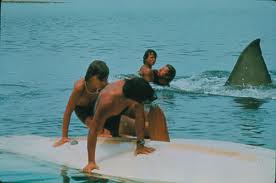
Deemed too gruesome for the final film, I’ve only glimpsed a bit of the original estuary scene in “The Making of Steven Spielberg’s Jaws” doc available on the Jaws Anniversary DVD.

The hapless boy scout leader (played by stuntman Teddy Grossman)  has fallen out of his little rowboat, been dragged under, lost an athletic (and still sneakered)  leg.  In the unedited version, we see him propelled by the shark, pushing  Michael Brody out of harm’s way as the fish pushes him out to sea.

Excessive gore aside, I read somewhere that Grossman was a bit too hammy in this scene which could be another reason Spielberg axed it.

It’s still my favorite part in the movie, even its edited form–the, sweet oblivious Grossman (“Hey, you guys need any help?)  trying to tell the boys how to tie a knot while the fin speeds toward him is full of pathos and terror.

I remember staring at a photo included in the JAWS log, (a childhood bible of sorts),  that showed Grossman with blood pouring out of his mouth as thick and dark as chocolate syrup, his eyes cast back at that towering fin escorting him to oblivion. There’s something weirdly religious about the martyrdom and the blood in this scene–the Christian sacrifice in the mouth of the  pagan God.

Day 86 9/19/13: Meditations on a Gaping Maw

I’ve been meditating for a little over a year now. I try to do it twice a day, although I admit sometimes I miss a session or two. But my meditations aren’t limited to those periods that I sit for twenty minutes with my eyes closed. Lately, I’ve been concentrating my attention on this image of a great white. I’ve posted it before. I don’t know what exactly sets it apart from countless other terrifying images of white sharks with tooth-ringed-death-tunnel-cavern-mouths, but in this particular photo, the shark not looks as if it has ambushed its prey (the viewer?) but is itself, startled, surprised.

In my anthropomorphic projection, I read a sense of wonder in the black eyes and open mouth.

As I study this picture,  I remember something from the meditation lecture I went to a month or so ago in which Thom Knoles paraphrased the words of Guru Dev:

Transcend where you are

Go Beyond the field of thinking

Master non-thinking

Then Transcend that

After that my lecture notes are garbled, excited. Words like “simultaneous,” “integrate,” and  “alternate” fill the margins.

When I go beyond thought (thoughts largely involving “terror” and “death”), what is there besides the creature itself?  If I go beyond thought, am I then allowed to take in the silence of the shark, its essence, which feels a little like cold sea water seeping in under my skin?

Yesterday, I had students respond to E. O. Wilson’s famous line, “In a deeply tribal sense we love our monsters.” Why do we love them? I asked the class, scrawling their ideas on the board. “Because they are free,” someone shouted. “We want their freedom.”

Maybe this solitary project should become a group meditation.

Shark Attacks, Consumes Christian Fundamentalists

Shark Attacks, Consumes Christian Fundamentalists

Hoping to settle the long-standing debate about whether Jonah was swallowed by a whale or a shark, Sarah Sprague and Ruth Tippit, two Biblical literalists, eagerly dove into the waiting jaws of a 16-foot white shark armed only with a candle stub and a book of soggy matches. This photo, taken by their pastor, Reverend Foote, shows the brave zealots’ final glimpse of planet Earth—the chum-slick waters off Anacapa Island.

Day 67 8/31/13: Sharks, Shame &Oral Fixations

Preparing for my shark class, I started feeling anxious. Will I strike the right balance between fun and conservation? Will I inspire any one of my students to actually do something about the oceans?Regretting my unfortunate choice of textbooks, I felt on the verge of falling into a major shame spiral about my skill as a teacher, which inspired a kind of greatest hits medley of degradation.

For example,  the familiar domino effect of paranoia and self-loathing I’ve often felt in the course of romantic love:

I fear you will notice my hopelessness at chess, sex, sports, trivia, cooking, dancing, and abandon me. Exposure of my inadequacy will then lead to exile from the larger community, which sensing my lack of fitness, will leave me to perish alone like a deformed animal.

Or something like that.

Sharks evoke a curiously liberating kind of fear—the ring of teeth, the lurid jaw and cavernous throat are primal, immediate. The horror of being consumed by a large fish doesn’t ignite the tedious chain of psychological causes and effects that the proximity of an intimate relationship does.

My first therapist Joyce, was not only a beautiful ex-model who collected Jasper Johns drawings, but an astute Jungian. I’d always had a rich dream life. Lucid dreams. Even premonitions. I told Joyce that I’d dreamed of sharks since childhood, hoping she might seamlessly link my dysfunctional family confessions with some deep-sea mythos of the subconscious.

Instead she stared at my ragged fingernails.

“Well, you’re very oral.”

I  took exhaustive notes during our sessions.  The pens I wrapped my ragged fingers around were invariably dotted with teeth indentations, the caps deformed and squashed by my clumsy molars. As a child I obsessively chewed free library bookmarks, cupcake papers and lollipop sticks to awkward mush balls, a habit that evoked both pleasure and shame.

At the time, I felt disappointed at Joyce’s spare, more Freudian than Jungian response, but over 23 years later I feel grateful to her. Instead of spinning a narrative about submerged anxieties stalking me until I faced them, Joyce aligned me with the powerful creatures I feared.

In some strange way, she made me one of them.

Day 64 8/28/13: The Shark as Spiritual Vehicle

I feel (is it liberal guilt?) when I explore the terror sharks inspire rather than reiterating the urgent fact that we are the true monsters of Planet Earth killing 100 million sharks a year. There I said it. Now, in my ongoing quest to define all the nuances of terror that sharks inspire, here is a passage from the  Illustrated Book of Traditional Symbols that adds a mystical dimension to the primal human fear of being eaten alive:

“The jaws of the monster depict either the gates of hell and entry into the underworld, or they share the symbolism of the clashing rocks, the wall with no door, the eye of the needle, etc., as the contraries, polarity and duality, which must be transcended in order to attain to the ultimate reality and spiritual enlightenment, they must be passed in the “timeless moment.”

Passing through the jaws of the monster is then a heroic trial,  a “difficult passage” from one plane of existence to another, a journey that is impossible in the physical body.

In my perverse spirituality, the shark’s resonance as a terrible God-vehicle is as powerful an argument for conservation as the obvious necessity for apex predators in balanced oceans. But I know it’s a tad esoteric for the op-ed page.

Day 55 8/19/13: 10 Things I Did Instead of Studying My Dive Manual

Shark!

Shark! (Photo credit: guitarfish)

1. Read about the swift but gruesome death of abalone diver Randy Frye in the waters of Northern California.

2. Watched a mini-documentary on technical diver David Shaw who died trying to retrieve the remains of another diver from the depths of a dangerous cave.

3. Meditated for 20 blissful minutes that were occasionally invaded by thoughts of decompression chambers.

4. Felt less alone after reading several articles criticizing OCEARCH’s machismo and brutality.

5. Marveled at Denise Levertov’s briskly paced poem The Sharks. 

6. Tried to do the dishes mindfully, but spaced out and started worrying about August almost being over, a reverie broken occasionally by hummingbirds.

7. Ate fruit

8. Thought again about Thom Knoles–of the failure of the stressed out intellect and how the expansive silence of meditation feels so nurturing, so full of presence.

9. Wondered for the trillionth time about the basic goodness or evil of mankind.

10. Marveled at the ability of writing to redeem boredom and to reveal the miraculous within the ordinary.

Day 54: 8/18/13: Everyone Should Read This (and I don’t mean that as arrogantly as it sounds)

Maharishi Mahesh Yogi, The Beatles and their c...

Maharishi Mahesh Yogi, The Beatles and their companions posed on a dais, image by Paul Saltzman. (Photo credit: Wikipedia)

Thom Knoles is a funny, grounded and warm meditation teacher who studied with the Maharishi Mahesh Yogi in the late 1960s, I think he may have overlapped with the Beatles’ tenure in Rishikesh. I felt like too much of a Beatles nerd to ask when I learned Vedic meditation from him last year.

Learning to meditate  was one of the greatest decisions I ever made.

Thom opened the lecture with this anecdote about speaking at the G8 summit. “I was the only one there wearing beads,” he laughed.  “Everyone here is suffering from chronic brain failure,” he said to the assembled leaders of the world. “Nothing’s going to come of this summit. Any questions?”

I don’t know how the G8 leaders reacted to that, but the crowd at the Santa Monica Marriott really dug it.

In a metaphor I remembered from the meditation class, Thom compared the human brain to an overloaded iphone that can barely process any new information. Decisions made using 2% of the stressed out overtaxed human brain are never going to solve terrorism, global warming, etc.

That’s where meditation comes in. And dharma. And karma.

Dharma is our personal role in the evolution of the universe. When we are living in dharma, doing what we’re meant to be doing at any particular moment, living is effortless and expansive.

To understand what we need to do, to know our dharma, Thom says we must learn to recognize and be receptive “in our least excited state”(meditative) to what “charms us” and to recognize what we have an aversion to.

Karma, on the other hand, is not the word plastered on tip jars in coffee shops. Karma is, according to Thom, “an action that binds.”

“The universe is not angry with us,” he explained. “It’s not punitive. It’s just hoping we figure things out.”

Unlike dharma, karma is restrictive. It is what we experience when we base our decisions purely on intellect and inaccurate assumptions. For example, “If I just keep doing this work (that I don’t really love) it will become something I love.” Or “I will repeat  the familiar even though the familiar makes me unhappy.” Karma is that corrective suffering that happens when we refuse to take risks, when we cling to the known world, when we are not courageous.

And like Thom’s brief address at the G8 summit, today’s talk at the Marriott was ultimately about courage:

“Find out what you should be doing. Embrace potential. Is it enough for you to continue eating, sleeping, pooping, taking up space on the earth? We must make our existence relevant. Urgently examine what you’re capable of giving to the world. Be courageous.”