Day 202 1/13/14: Some Blogs I Dig: Part 1

dog-blog1

I have only yet begun to catalogue the blogs I love. Here’s a few to start:

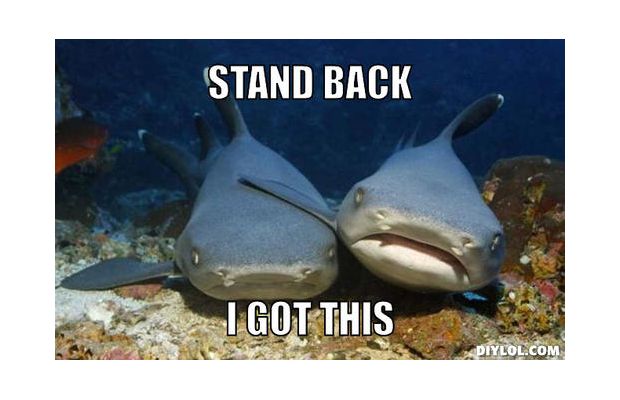
1. Fuckyeahsharks is really fun! Great shark gifs, shark pix and more.

2. I’m always amazed at the fearlessness & intelligence of The Daily Headache.

3. I LOVE this blog! Biblioklept is a daily surprise and delight if you love art & lit.

4. Walking with Alligators: Helping endangered creatures in the Everglades & beyond.

5. Find out how recent wolf & coyote hunts and other wildlife massacres screw up the ecosystem at  Exposing the Big Game.

6. Sofastory: Every abandoned couch has a lurid & lovely tale to tell on this Tumblr blog.

Day 176 12/18/13: A Hodgepodge of Cool Shark Stories

(Very Cool) Read this to learn how prehistoric sharks escaped extinction.

I love these guys! Australian Activists Fight the Shark Cull.

Wanna sign a petition banning the import of shark fins to Canada? OF COURSE you do!

A touching story of maternal instinct: Lemon Shark Moms in the Nursery! 9

Day 157 11/29/13: Sea Shepherd’s Shark-Saving New Film

Sea Shepherd Conservation Society

Sea Shepherd Conservation Society (Photo credit: Wikipedia)

It’s true. Sharks could be extinct in 30 years.

Some populations may disappear within a decade.

For the last three years, Sea Shepherd has been working on a documentary in collaboration with the union of environmental lawyers in Latin America to help educate the environmental legal community. This film is the first of its kind designed to educate and inspire environmental prosecutors.We need to not only to create tougher shark finning laws, but to make sure that they’re enforced. We need to keep marine sanctuaries safe from illegal finning and get tougher convictions for ocean-related crimes.

This is is such a good cause, and you can be a part of it for as little as $1.00!

Day 147 11/19/13: Anatomy of a Shark Breach

Day 147 11/19/13: Anatomy of a Shark Breach

Ever wonder about the miraculous physics behind the white shark’s breaching behavior? Please refer to this handy chart from the folks at White Shark Advocacy.

Day 144 11/16/13: Shark Dreams in Kindergarten

Friday afternoon I grabbed my inflatable shark head and drove to Cameron Elementary in West Covina to teach Gail Gibson’s kindergarten class all about sharks.  I was nervous. Bored twenty-year-olds I could handle, but I didn’t know about children. I hadn’t crossed into that strangely lovely world of tiny chairs, knee-high sinks and loping, floating handwriting since about 1973. But the kids were great. Cute. Smart. Well-behaved.  For the first part of the class I sat in a rocking chair (as befits a wise storyteller), and tried to answer their questions. Frankly, if Ms. Gibson hadn’t given me a “preview” of these sophisticated topics I would have been, to quote David Foster Wallace, “totally hosed.”

“Why do sharks live in salt water?”

“Why do tiger sharks eat garbage?”

After frantically googling the answer to the salt water question, I discovered that other 5-year-olds had pondered this very thing, but the  was a tad too complex for me to understand let alone translate into kid-ese. Another site’s explanation seemed too easy, so I opted for an evasive kind of truth about how each animal had a job to do and a shark’s job involved swimming in the ocean and eating the sick and dying so as to maintain a balance. I might have talked about sharks maintaining a balance too much, but perhaps the importance of a shark’s role in the ecosystem can’t be overstated.

I thought the tiger shark ate dolls and rocking chairs and old tires because his diet is so wide and varied that the tiger considers anything floating as potential food. I realized that this answer might be disappointing too, so I quickly tossed in a gross-fun-kid-friendly fact. “Did you KNOW tiger sharks can actually throw up their own stomachs to get rid of things they can’t digest? Their whole stomach comes out of their mouth,” I added, clearly more infatuated with this than the kids.

A boy named Maddux raised his hand. “I like to eat paper.”
In the second half of the class, the kids painted watercolor sharks. Some sharks had gumdrop teeth and fat, hunched manatee bodies. Others wore yellow crowns. Some kids drew menacing dorsal fins, while for others the tell-tale triangle appeared a mere afterthought. One girl begged to be able to paint her shark rainbow colors, though she was careful to cover the teeth in a wash of red paint. A few of these tykes are born abstract painters, obscuring all representation save for a furious, black scribble (the mouth), and slathering layer upon layer of wet color until the paper dripped.

The children sang me a song about the months of the year and showed me. They used drinking straws to show me how to figure out the ones, the tens, the hundreds. A boy in a striped sweater wrapped his arms around the inflatable shark head and kissed the lurid, toothy mouth. Priscilla carried the shark head like a battering ram. They asked me where the rest of the shark’s body was. They asked the best question of all: “Why do you love sharks so much?”

And I was happy with my answer: Because sharks are scary, and they’re beautiful. They’re ugly. Because they look  like a monster. They look like something make believe, but they’re not. They’re a miracle. They actually live in the world.

Image

Day 143 11/15/13: Celebrate Whale Sharks

English: whale shark Deutsch: Walhai

English: whale shark Deutsch: Walhai (Photo credit: Wikipedia)

Behold the beauty!

1. Conservation Meets High Art/Fashion: Photographer Shawn Heinrichs made these gorgeous images of whale sharks and their “mermaid” counterparts.

2. Sign This: Help Whale Sharks & Their Brethren by keeping state finning laws strong.

3. Whale Shark 101: a great 3-minute video about the world’s largest fish.

4. This Just In: Indonesian Fishermen free juvenile whale shark caught in fishing net.

5. Where do they go? Listen & Read: NPR’s story on the mysteries of whale shark migration.

Day 132 11/4/13: Epiphany, Misanthropy & Scalloped Hammerheads

I just stumbled on this piece by a scuba diver and self-proclaimed atheist who found God in the eyes of a white shark off Guadalupe Island.

I needed an epiphany like this to heal the horror of a student presentation given in my 10:40 class. After outlining the habitat, biology of the endangered scalloped hammerhead shark, the student played a clip in which some smug idiot catches a juvenile scalloped hammerhead and holds the small shark on the deck pointing out its distinguishing characteristics while the fish gasps, thrashes and finally dies on camera. I felt like placing a bag over the man’s  head and asphyxiating him while calmly identifying the major appendages that identify him as a Homo sapiens.

My meltdown drowned out the asinine anatomy lesson.  I tried to turn my rage into a “teachable moment.” As the shark’s death seemed to happen in the name of education,  I talked about the destructive “research” of OCEARCH and urged the class to write about corruption in marine conservation. “Please tell me,” I said to the darkened classroom, “how I can continue to witness things like this and not become totally hopeless. Can you guys answer that on the final?”

They nodded sympathetically.

“It’s like zoos,” one girl said. She didn’t elaborate, but I guess I understood.

Lou Reed was right: “You need a busload of faith to get by.”

But sometimes faith involves more forgetting/denial than it does hope.

Lou Reed also said “that caustic dread inside your head will never help you out.”

A conscious rejection of too much negative thinking is another necessity of “getting by.”

Lou Reed’s death leaves me feeling a bit lonely for this kind of immediate connection, this ability to cut fearlessly through to the truth.

It makes me want to be less straitjacketed by wanting to be liked and not being afraid to show how incredibly angry and sad all this stuff with animals makes me feel without trying to wrap it in what David Foster Wallace called “rhetorical niceties.  But I don’t want to rant self-righteously either.  I hope I can find some place in the middle of anger and reverence, joy and despair that isn’t too middle of the road. 

Scalloped hammerhead (Sphyrna lewini)

Scalloped hammerhead (Sphyrna lewini) (Photo credit: Wikipedia)

Day 125 10/28/13: Remembering Lou Reed, Andy Warhol & An Old Horse

I wanted to write about the shark presentations my students gave, but most of them were lifeless recitations of Powerpoint slides, and I found myself thinking more about Lou Reed.

I played his music all last night.

What does it take to crack open the human heart? I don’t know why I’m surprised at my depth of feeling at Lou’s death.

Had I forgotten the heavy thrill of buying my first VU album, “White Light, White Heat,” of memorizing “The Gift”? How I used to keep a picture of Lou Reed in my photo album among images of my family? Why did I not even own this music I loved so much anymore? I’d memorized every song.

Between classes, I tried to lose my despair over the death of a major artist and the death of collective student imagination, in an essay about horses called “Partnering with Pegasus.”  Mares are the true leaders of the herds, not stallions.  I started thinking of 1992,  the last time I saw my childhood mare-ribsy and grizzled, 35 years old coming over the edge of a hill. She nickered when she spotted me, but I, shocked at her appearance, gasped.

Then we both froze staring at each other.

What a great surprise to find that horse standing in that field again.

The image hung there, and suddenly infusing that lost world was John Cale singing “The Style It Takes” a gentle song about Andy Warhol:

I’ll put the Empire State Building on your wall,

For 24 hours, glowing on your wall

Watch the sun rise above it in your room,

Wallpaper art, a great view…..

Did they always belong together this unlikely memory pair–an elderly horse and lonely Andy Warhol?

I started thinking of that well-worn Camus quote about having an infinite summer within. The places I’m afraid to return to, those fields, those songs (which are also places), are sites of renewal. Loss numbs and loss  surprises. Like music it wakes us up again to the dream of life.

Day 123 10/26/13: Shark on a Bus & Other Stories of Creative Conservation

images-5This eccentric Australian diver/environmentalist travels the countryside in a bus filled with marine artifacts including a 5 meter white shark to educate the public about “killer” sharks. Admission fees collected for his “mobile museum” are donated to ocean pollution campaigns.

And on the subject of unusual forms of advocacy, check out this interview with Debbie Salamone of Shark Attack Survivors for Shark Conservation….I also just discovered Operation Blue Pride, a group injured war veterans that have come together to dive with sharks and promote awareness about ocean conservation.

Day 118 10/21/13: Sea Fragments

School passed in a blur of dangling modifiers, wordy and mixed constructions and about twenty-four recitations of sea poems by Frost, Baudelaire, William Carlos Williams, Marianne Moore and that time-traveling favorite “Anonymous.” One student recited a poem I had memorized and recited in 1979, John Masefield’s “Sea Fever.” It is amazing to me that I remember even a fragment of a stanza of “Sea Fever,” since I can’t remember what I had for lunch–but certain phrases whip and twist around my head like ghost nets. Simple juxtapositions–“the lonely sea and the sky,” and the hurried feeling (then & now) of “a gray mist on the sea’s face and a gray dawn breaking.”

I could tell which students connected to the specifics (the curve of a shell) or believed, as Marianne Moore believed that the sea is “a grave.”

The language of effective conservation has to include poetry, science and humor. It has to become a lasting and permanent force inside us, not something we dutifully digest and regurgitate in slogans–although I spotted the words MORE BIRTH LESS EARTH spray painted on the side of rusted bridge over the 101 Freeway, about 20 years ago. It’s stuck with me as stubbornly as any poetic fragment.

P.S. I hope it’s true that demand for shark fin has declined 50-70% in China.

John Masefield, Hampstead, January 1st, 1913.

John Masefield, Hampstead, January 1st, 1913. (Photo credit: Wikipedia)